Floor fan
18–24 Inch Industrial Floor Fan: Specs, Airflow and Pricing (2027 Guide)
18 and 24 inch industrial floor fan specs, airflow calculations and 2027 EXW pricing bands — motor, blade and certification cost drivers explained.
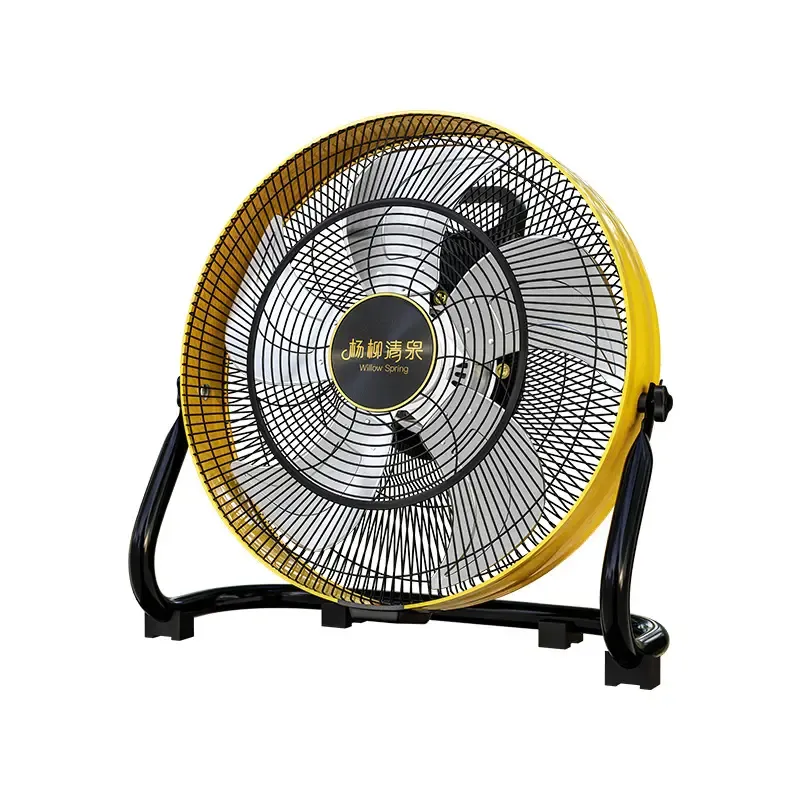
Quick answer: An 18-inch industrial floor fan typically moves 3,000–5,500 m³/h (1,800–3,200 CFM) on 90–150 W, which suits spot cooling, drying and tight aisles. A 24-inch unit moves 6,500–9,500 m³/h (3,800–5,600 CFM) on 180–280 W and is the better choice for open workshop floors and warehouse circulation. Indicative 2027 China EXW pricing runs about USD 18–38 for 18-inch and USD 32–65 for 24-inch with copper-winding motors and CE certification. To size a room, multiply floor area by ceiling height to get volume, then multiply by the air changes per hour your application needs.
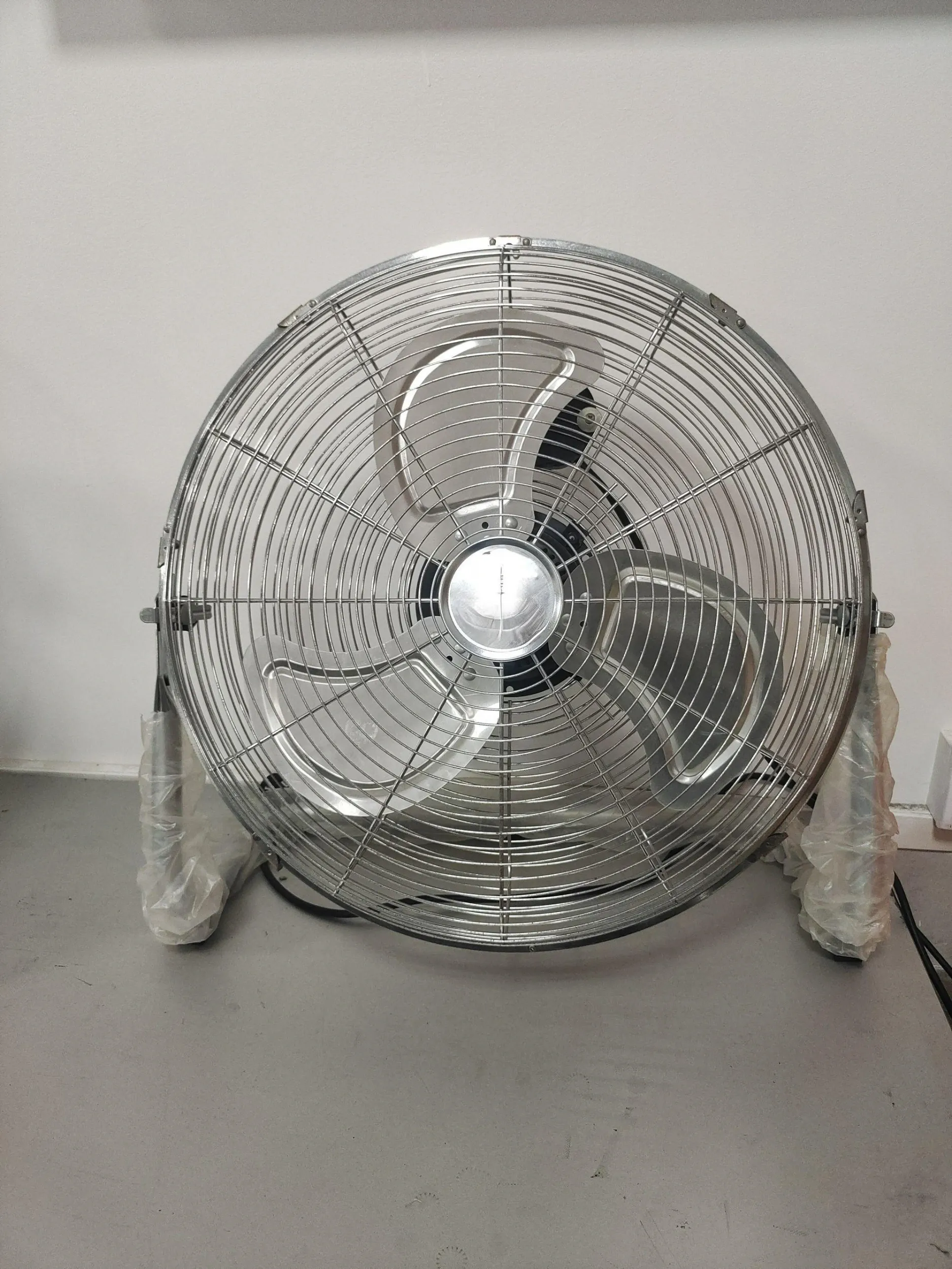
Why 18–24 Inches Is the Practical Middle
Industrial floor fans are sold from 14 inches up past 36 inches, and the two ends solve different problems. Small 14–16 inch units are portable and cheap, but their airflow is limited and they are best treated as personal cooling. A 30-inch heavy-duty industrial fan does deliver real air movement and suits factory floors, but the machine weighs 20 kg or more, needs a planned footprint, and costs enough that it is a commercial purchase rather than something you buy several of.
The 18–24 inch band sits in between. It works for company procurement, for distributor private-label programs and for individual buyers, which is exactly why it is the most versatile and most popular size range — and why it outsells both ends in B2B orders:
- 18 inch — light enough for one person to move, strong enough to cool a work cell, dry a floor or push air down an aisle
- 20 inch — the volume size many distributors carry as their best-selling SKU
- 24 inch — the smallest size that still works as general circulation for an open workshop rather than spot cooling
If you are stocking a range rather than buying for one building, 18 and 24 together cover most of the demand you will see from warehouses, workshops, gyms and poultry houses.
Specs: What Each Number Actually Means
A floor fan datasheet is short, but a few of the numbers are routinely misread. Here is what matters.
Spec | What it tells you | What to watch |
Fan diameter | Blade sweep, and therefore the ceiling on airflow | Nominal size is not the blade's true diameter; ask for both |
Airflow (m³/h or CFM) | Volume of air moved per hour | Measured at free air; drops sharply once you add ducting or a guard |
Power (W) | Electricity draw at rated speed | Compare W per 1,000 m³/h, not W alone — that is efficiency |
Speed (RPM) | Blade rotation at max setting | Commercial and industrial floor fans run higher RPM than household fans, so RPM is a rough proxy for the air speed you actually feel at the worker |
Noise (dB(A)) | Sound pressure, usually at 1 m | Confirm the measuring distance; 3 m figures look much better |
Static pressure (Pa) | Ability to push air through resistance | Only relevant if the fan feeds ducting or a wall opening |
Net weight (kg) | Portability and shipping cost | Also a proxy for motor and housing quality |
Voltage / plug | Market compatibility | 110 V/60 Hz vs 220–240 V/50 Hz, and plug type by country |
Typical specs by size
The table below reflects the ranges you will see across Chinese factories for industrial floor and drum fans in this class. Treat it as a benchmark for reading quotes, not as a guarantee for any single model — always confirm against the actual datasheet and a test report.
| 18 inch (450 mm) | 20 inch (500 mm) | 24 inch (600 mm) |
Airflow | 3,000–5,500 m³/h (1,800–3,200 CFM) | 4,500–7,000 m³/h (2,600–4,100 CFM) | 6,500–9,500 m³/h (3,800–5,600 CFM) |
Power | 90–150 W | 120–180 W | 180–280 W |
Speed | 1,100–1,400 RPM | 1,000–1,300 RPM | 900–1,200 RPM |
Noise at 1 m | 55–65 dB(A) | 58–68 dB(A) | 60–70 dB(A) |
Net weight | 6–10 kg | 9–14 kg | 12–18 kg |
Typical use | Spot cooling, drying, aisles | Mixed duty, volume SKU | Open workshop, warehouse |
The efficiency column is the one buyers underuse. Divide airflow by power and you get m³/h per watt. A 24-inch fan at 8,000 m³/h on 200 W delivers 40 m³/h per watt; a cheaper unit at 6,500 m³/h on 280 W delivers 23. Over a summer of 10-hour days, that gap is the electricity bill.
Airflow: How Many Fans Does the Space Need?
Two different questions get confused here, and the answer changes by a factor of three depending on which one you are asking.
Question 1: Spot cooling (how many people or workstations?)
For cooling people rather than ventilating a volume, the rule of thumb is 1,500–2,500 m³/h per workstation, delivered at 2–3 m/s at the worker. An 18-inch industrial floor fan handles one or two stations; a 24-inch industrial floor fan handles three to four if positioned to cover them.
Question 2: Whole-space ventilation (how much air for the room?)
For air exchange, use volume and air changes per hour:
Required airflow (m³/h) = floor area (m²) × ceiling height (m) × air changes per hour
Typical air change rates:
Space | Air changes per hour |
Warehouse, storage | 6–8 |
Assembly workshop | 8–12 |
Gym / sports hall | 8–10 |
Poultry house | 15–20 |
Drying room | 20+ |
Worked example: a 40 m × 20 m workshop with a 6 m ceiling is 4,800 m³. At 8 air changes per hour you need 38,400 m³/h. At 8,000 m³/h per 24-inch industrial floor fan, that is roughly five units — but only if the fans are positioned to move air through the space rather than around it. Placing them in a line along the airflow path does far more than stacking them in a corner.
This is also where buyers discover that floor fans are not ventilation. If the goal is removing heat and fumes from a closed building, you need exhaust capacity at the other end; a floor fan only stirs the air inside.
Pricing: What Moves an Industrial Floor Fan Quote
Indicative FOB China pricing for 2027, copper-winding motor, CE certification, standard carton:
Configuration | 18 inch | 20 inch | 24 inch |
Aluminum winding, basic housing | USD 14–24 | USD 20–32 | USD 26–42 |
Copper winding, standard housing | USD 18–30 | USD 25–40 | USD 32–52 |
Copper winding, heavier housing, 3-speed switch | USD 22–38 | USD 30–48 | USD 38–65 |
DC brushless, variable speed | USD 40–65 | USD 50–80 | USD 65–105 |
These are order-of-magnitude bands for container quantities. Seven factors move the price more than anything else:
1. Motor and winding
The motor is 35–45% of the bill of materials. Copper winding costs more and runs cooler, more efficiently and longer. Aluminum is the single most common downgrade in a cheap quote, and it is invisible from the outside. Aluminum conducts less efficiently and builds up heat, which is what shortens the life of a cheap motor rather than any single failed part.
How the coil is wound matters as much as what it is wound from. Fully automatic winding machines lay the wire tighter and more consistently, which gives a cooler-running motor, a longer service life and stable quality from unit to unit. Manual winding depends on the operator's force and accuracy, so the result varies — and the failure rate is correspondingly higher.
2. Blade and housing material
Aluminum blades hold their shape at speed; plastic blades are lighter and cheaper but flex. Housing gauge matters as much — 0.8 mm steel and 1.2 mm steel look identical in a photo and behave very differently after two seasons of vibration.
Blade geometry is a cost driver too. A profiled, non-flat blade face moves more air but costs more to tool. Blade count works the same way: more blades mean more cutting edges engaging the air, which raises airflow — and raises the price with it.
3. Fan type
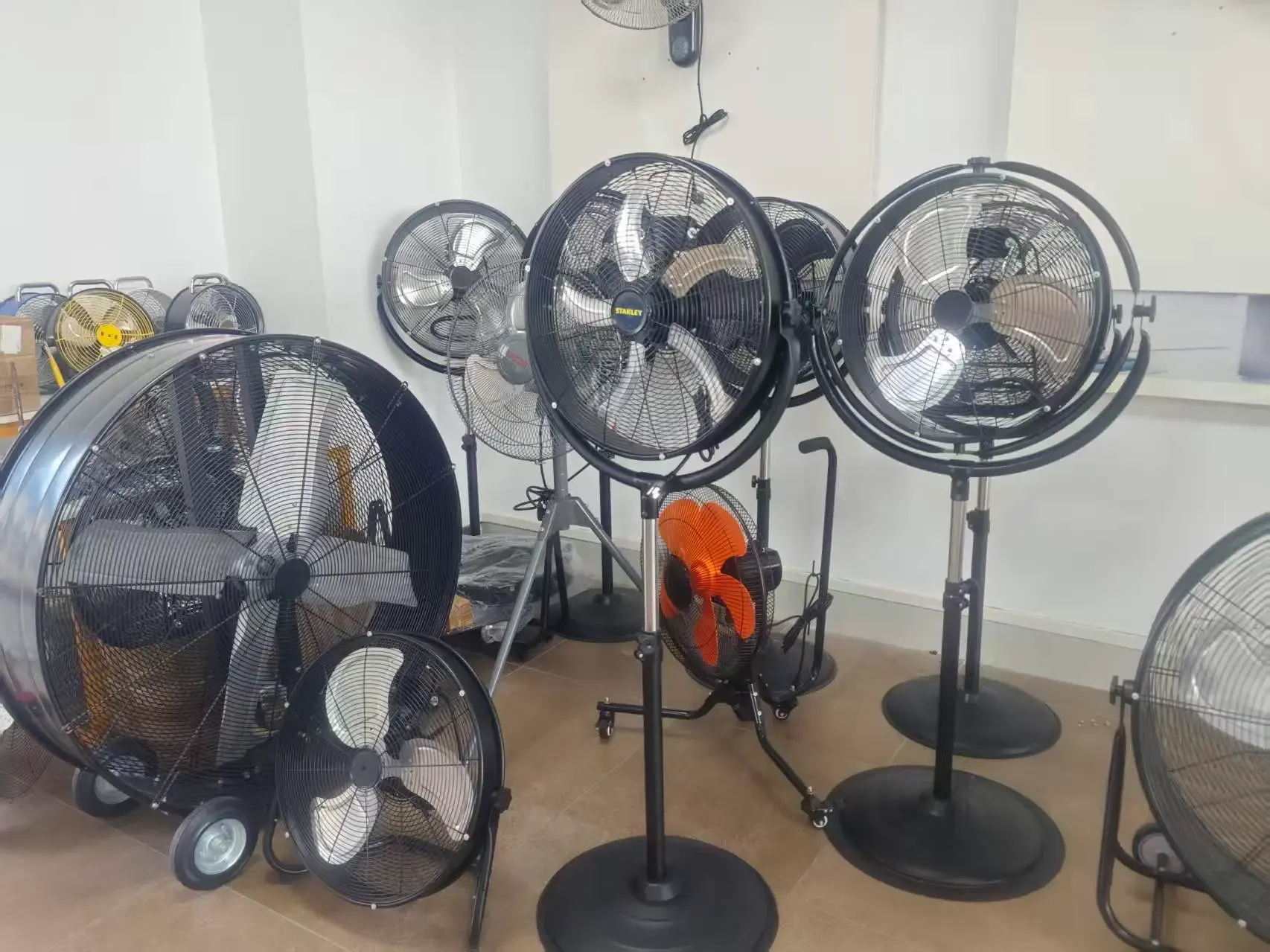
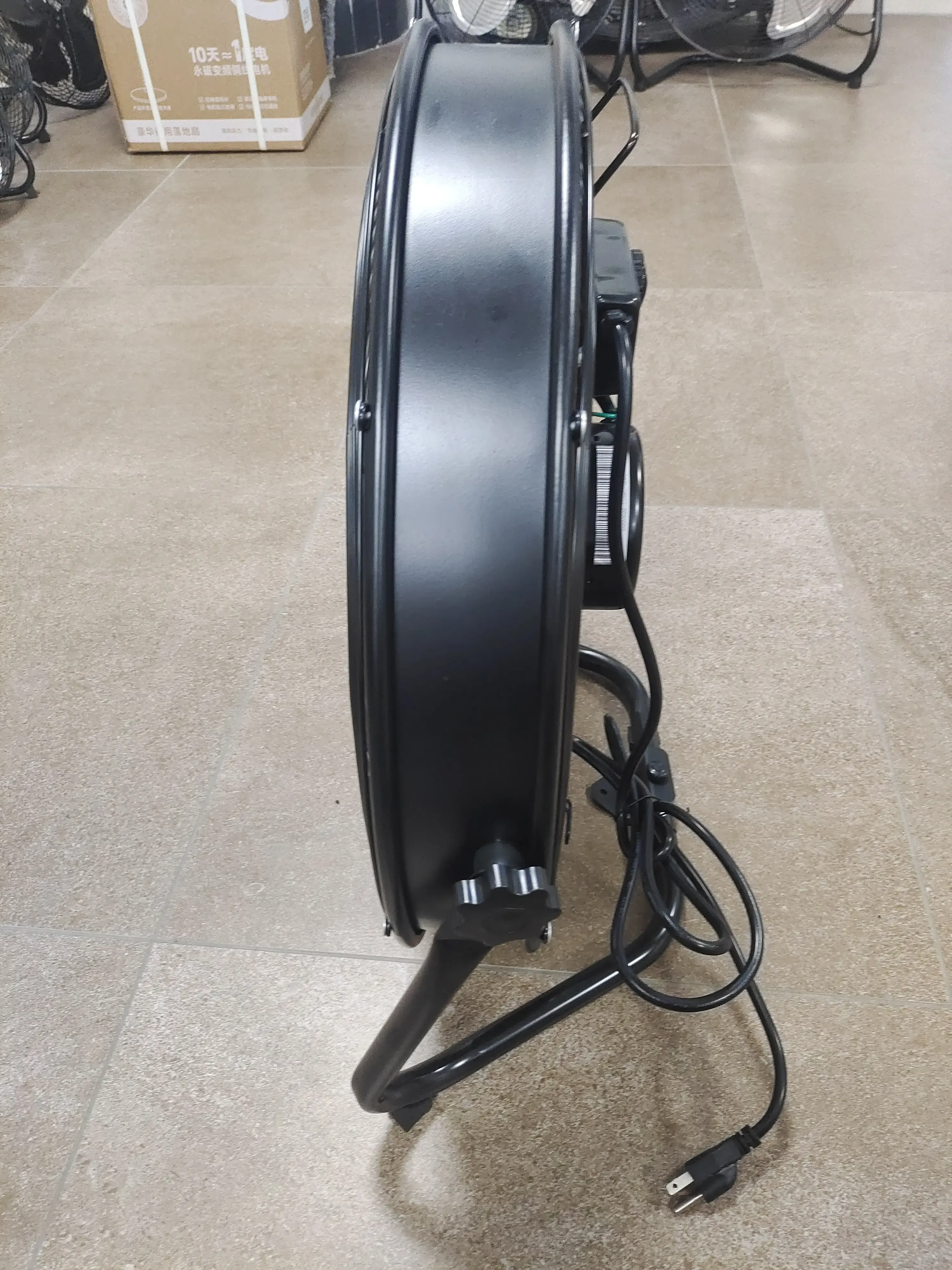
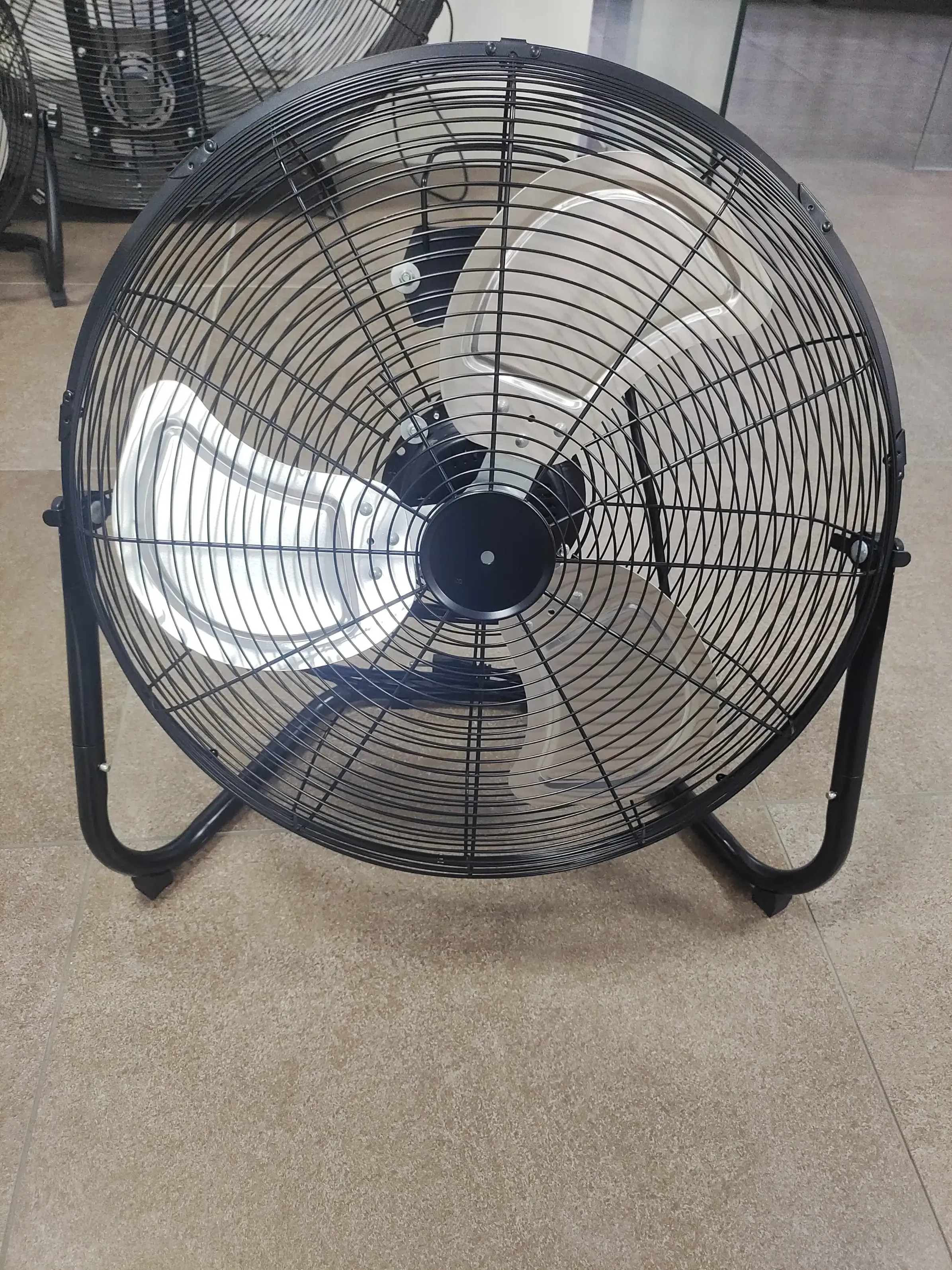
A basic floor fan has no additional design work in it. A commercial drum-type floor fan is the upgraded version: the barrel housing gathers the airflow and raises static pressure, so the air leaves faster and carries much further than a plain open-frame fan. Both the motor and the air concentration are strengthened, which is why the price is higher. If your buyer needs to reach the far end of a warehouse aisle rather than cool the two metres in front of the fan, this is the version to quote.
4. Certification
UL and CUL testing is a real cost and is charged per model. A CE self-declaration is cheaper than a TUV-issued certificate. If a quote is dramatically below others for the same specification, check which certificate is actually included.
5. Order quantity and packaging
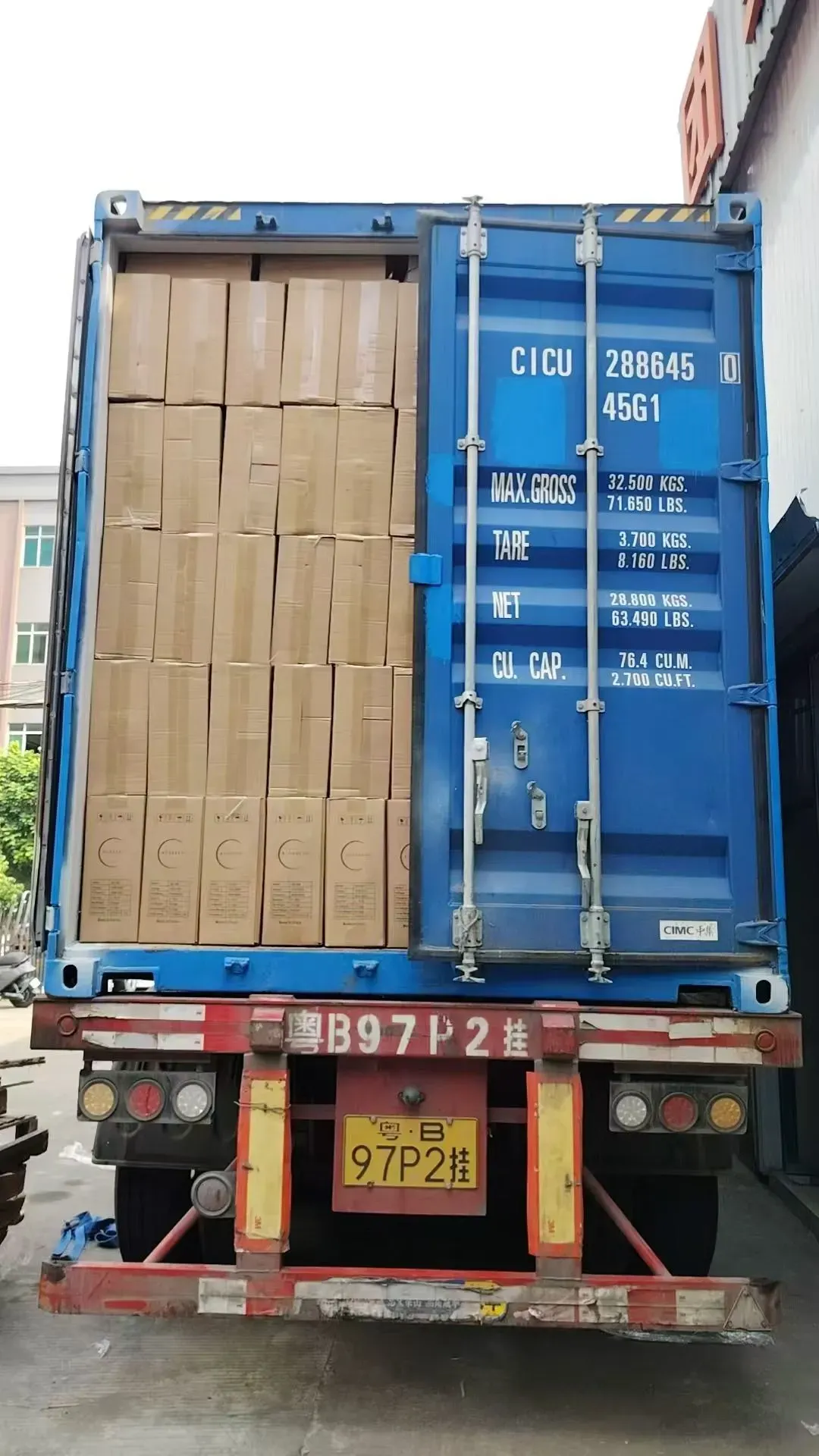
MOQ per configuration, carton versus wooden frame, and container loading efficiency all move the landed cost. A 24-inch fan packs fewer units per 40HQ than an 18-inch, so the freight per unit is higher even at the same FOB price.
6. Season
Floor fan demand peaks from April to July in the northern hemisphere. Booking production in February or March routinely costs less than booking in May, when factories are full and freight rates climb.
7. Factory capability
A factory with a complete production line — winding, motor assembly, body assembly, run testing and quality control, each staffed with trained operators and the right equipment — quotes differently from one that assembles from bought-in motors. The difference shows up in consistency across a repeat order, not in the first sample.
Where Each Industrial Floor Fan Size Fits
18-inch industrial floor fan — work cells, packing stations, loading docks, restaurants, drying wet floors after cleaning, and anywhere a supervisor needs to move a fan by hand several times a shift.
20-inch industrial floor fan — the general-purpose SKU for distributors. It covers enough floor to satisfy most small and mid-size buyers without the weight of a 24-inch unit.
24-inch industrial floor fan — shopping malls, open workshop floors, warehouse aisles, gyms, livestock buildings and event spaces. This is the size where a floor fan stops being personal cooling and starts being building circulation.
A pattern worth copying from experienced buyers: specify 24-inch units for the fixed positions and 18-inch units as the movable complement. It costs less than buying all 24-inch and covers more of the actual work. The principle behind it is simple — install a small number of heavy-duty fans or large ceiling fans to handle the base load, then use 18 and 20 inch floor fans where the work actually moves. You get the maximum cooling effect for the lowest total spend.
Spec Sheet Checklist Before You Order
Ask for these in writing, and compare quotes against the same list:
- Blade true diameter and nominal size
- Airflow in m³/h and CFM, with the test method
- Power draw at max speed, plus m³/h per watt
- Noise in dB(A) with measuring distance stated
- Winding material (copper or aluminum) and motor test report
- Housing steel gauge and blade material
- Net weight and carton dimensions with unit count per carton
- Voltage, frequency and plug type for your market
- Certificate numbers that match the model
- MOQ per configuration, lead time and warranty terms
FAQ
Is 18 inch or 24 inch better for a warehouse?
For spot cooling near workstations, an 18-inch industrial floor fan is enough and far easier to move. For general air movement across an open warehouse floor, a 24-inch industrial floor fan is the practical minimum — an 18-inch fan simply does not push air far enough to matter at 10 m.
How many 24-inch industrial floor fans do I need for 1,000 m²?
At 6 m ceiling height and 8 air changes per hour, you need about 48,000 m³/h, which is roughly six 24-inch fans at 8,000 m³/h each. Position them along the airflow path, not clustered, or the effective coverage drops sharply.
Why is one 24-inch quote half the price of another?
Almost always the motor. Aluminum winding instead of copper, a smaller stator, or a lower-grade bearing will halve the price and cut the service life by more than half. Ask for the motor test report before comparing the numbers.
Can these fans run continuously?
Copper-winding AC motors in this class are built for continuous duty, and factories commonly run them 10–12 hours a day. Aluminum-winding units are the ones that fail under that schedule. If your operation runs two shifts, specify copper in writing.
Do 18–24 inch floor fans ship assembled?
Most ship knocked down or partially assembled to save container space: blade and guard separate from the body, base separate. Assembly is a few minutes with basic tools. Confirm the packing configuration, because it changes the units per container and therefore your freight per unit.
Is it cheaper to buy industrial floor fans from China?
Yes — and buying from China is also what makes customization possible. You can specify blade material, housing gauge, voltage and plug type, motor winding and packaging, none of which a local distributor will re-tool for on a small order. The catch is that the savings only hold if you vet the supplier properly; the wrong factory costs more than the margin it saves. If you are not sure how to screen suppliers, start with a manufacturer-vetting checklist before you compare prices.
What motor speed do small industrial floor fans run at?
Small industrial floor fans typically run at 1,400–1,500 RPM, which is noticeably higher than a household fan. That is what gives them the air speed to cool a worker at two or three metres, and it is also why they are built with heavier motors and bearings than a residential unit.
Conclusion
The 18–24 inch range is where industrial floor fans stop being a commodity purchase and start being a specification decision. Get the airflow math right, insist on copper winding, compare m³/h per watt instead of watts alone, check which certificate is actually in the price, and verify the factory's production capacity and quality control in person — visit the plant if you can.
Sundream Fan manufactures industrial floor fans and drum fans in 18, 20 and 24 inch configurations in Zhongshan, China, with copper-winding motors, CE/UL certification options and OEM/ODM support. Send us your room dimensions, target market and annual volume, and we will come back with a sized configuration and indicative FOB pricing.