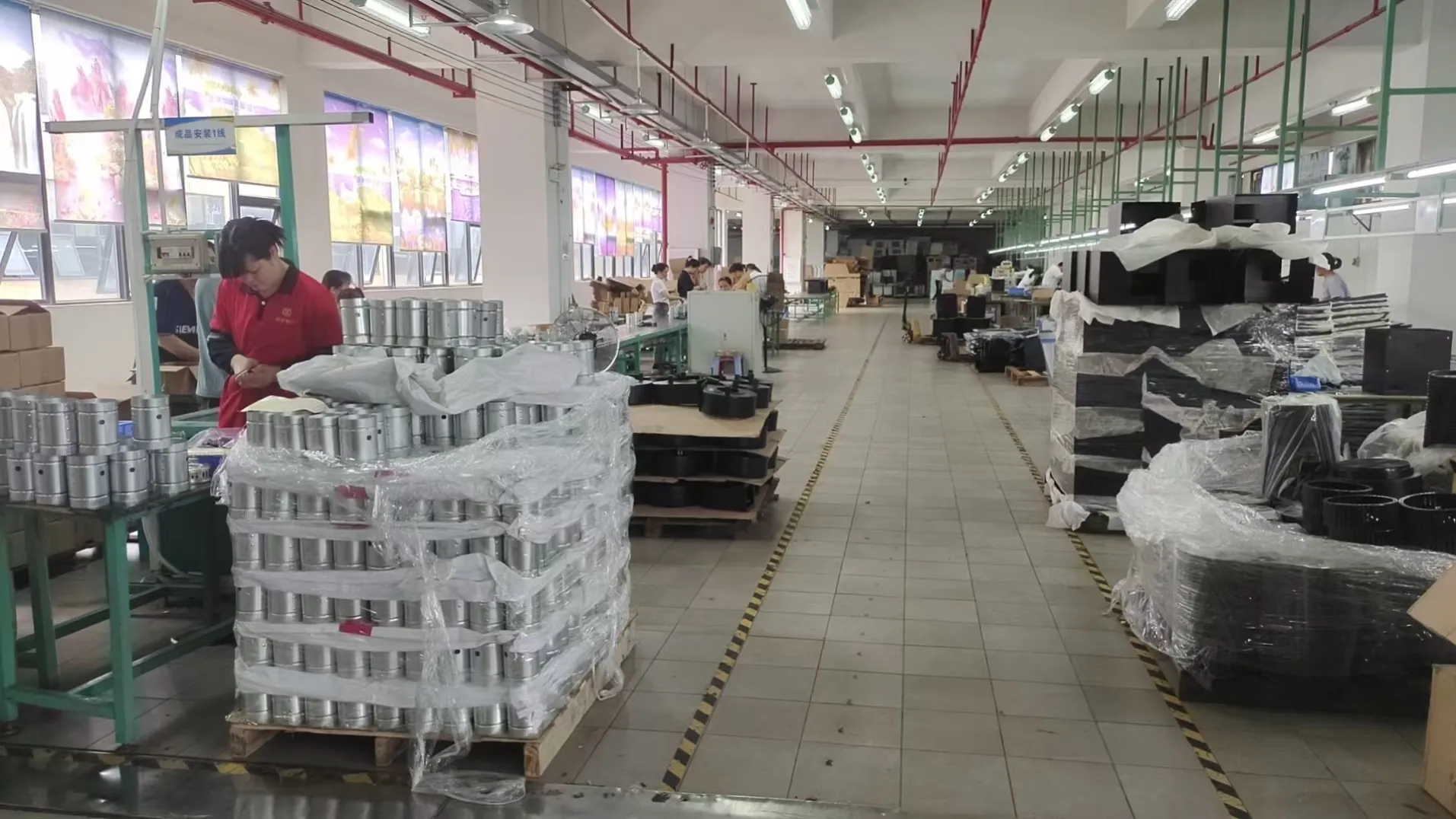
Floor fan
Drum Fan: Types, Specs and How to Choose One (2027 Guide)
Drum fan types compared: floor fan with drum head, 24-48 inch belt drive and 20-inch pedestal, with power, air speed, weight and container loading.
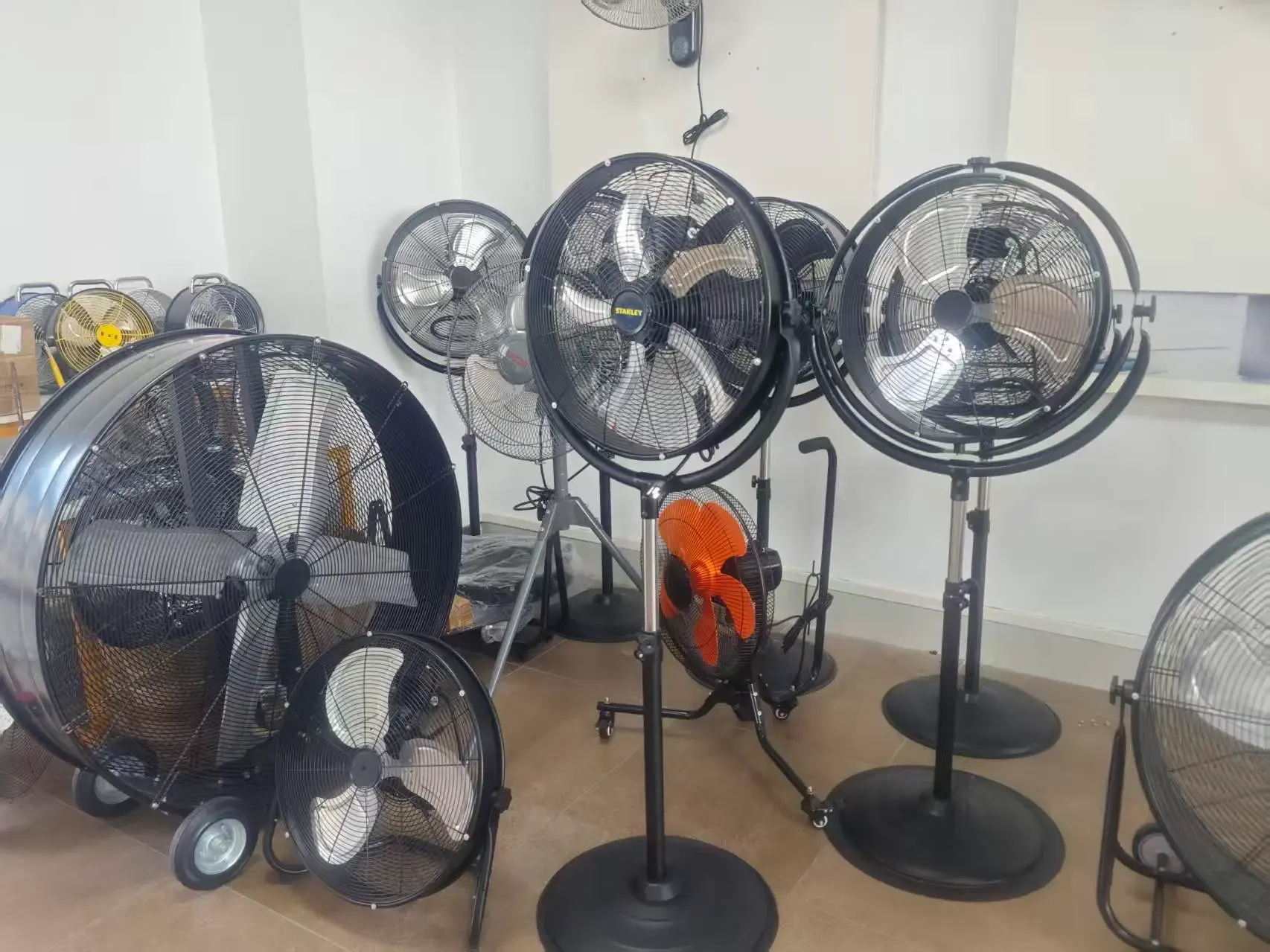
Quick answer: A drum fan is an industrial blower built around a round drum housing — a strong metal frame, a high-speed motor, and a barrel body that pressurises the air before it leaves. There are three shapes: the floor fan with drum head (16–20 inch, thin barrel, sits low), the belt-drive drum fan (24–48 inch, wide barrel, castors, the big one), and the drum pedestal fan (the same head raised on a column so the air arrives at working height). Buy the floor version for spot cooling and drying, the belt-drive version for large floors and long throw, the pedestal version where people stand at a line. A drum fan costs more than an ordinary floor fan and moves more air, more stably, for longer.
What Is a Drum Fan?
A drum fan — also called a barrel fan, a drum blower, or simply an industrial blower — is a tool that pushes a large volume of air across a large area, quickly. The shape is a round drum, the frame is built to take hard use, and the machine is made for continuous duty. You see them in warehouses, factories, gyms and on construction sites, in all the places where ventilation is not optional.
By moving air properly, a drum fan cools the people working (by cutting the heat they feel rather than the air temperature), dries wet floors, and clears heat, dust and smoke. In a large working environment, the right fan raises comfort, safety and productivity at the same time — which is why a workshop that buys one usually buys four.
The name matters less than the shape, and this is worth understanding before you compare prices. Buyers search for a drum fan, a floor blower, an air mover or a shop fan depending on which trade they come from, and the machine in the crate is often the same one. What separates a real drum fan from a cheap industrial floor fan is the barrel: a deep round housing that compresses the airflow before it exits, so the air leaves as a column instead of a cloud. That single design decision is what gives the type its throw, and it is the first thing to look at on a sample.
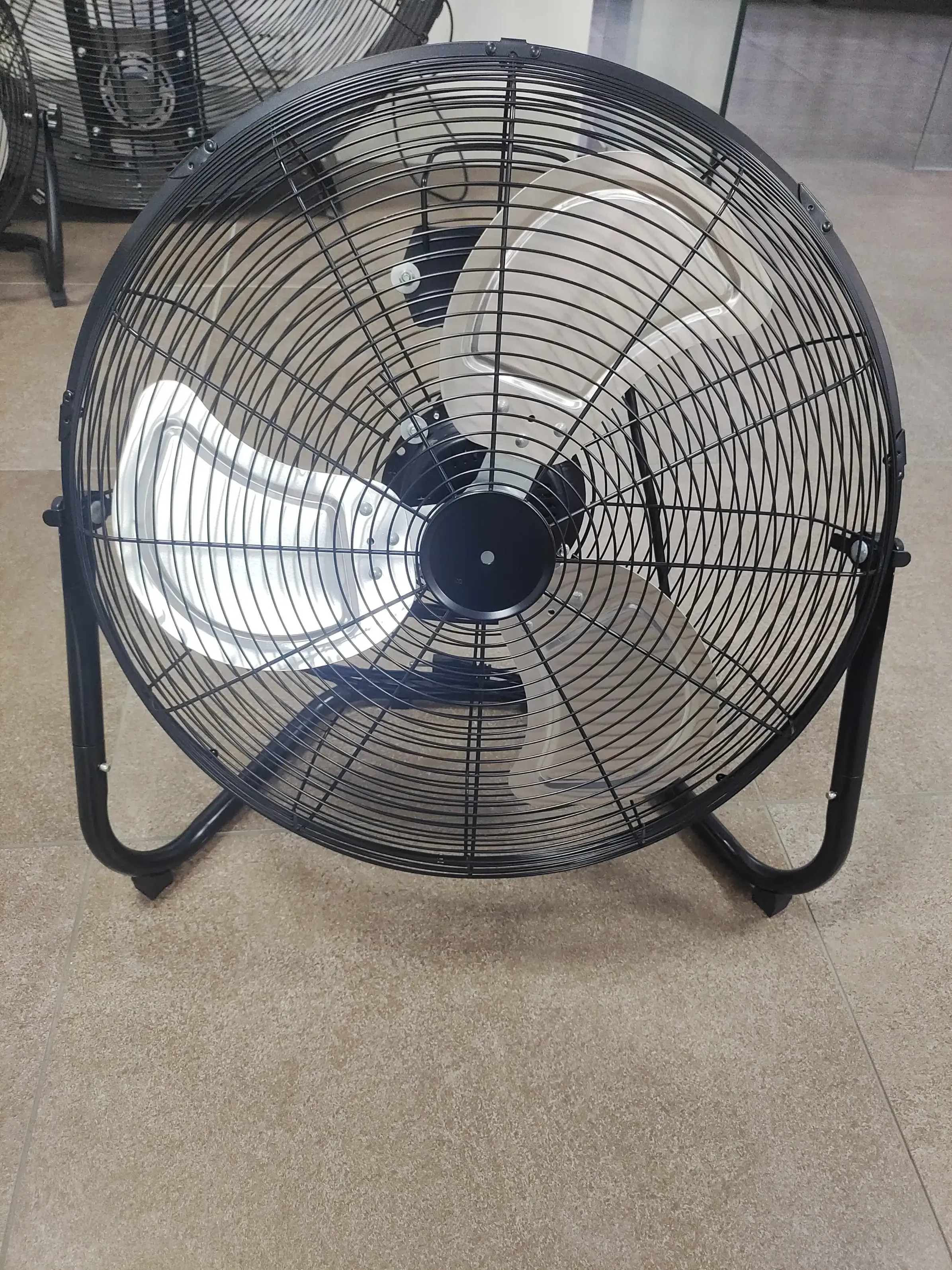
The Basic Components of an Industrial Drum Fan
An industrial drum fan is built from a handful of parts, and each one works with the others to hold a steady airflow under heavy load. Knowing them helps you specify the right machine and maintain it properly — and it tells you where a cheaper competitor has cut something out.
Drum housing. The round shell wraps and protects the blades and guides the air forward. High-performance industrial drum fans use a durable metal housing, which holds the shape rigid and cuts vibration. A plastic housing on a large barrel will drum and buzz within a season; on a 16–20 inch unit it is a legitimate cost saving, on a 48-inch one it is not.
Fan blades. The blades turn at high speed and push air across a wide area. A 24-inch drum fan normally uses profiled, angled metal blades — the pitch is what generates a larger, steadier airflow while keeping noise down. Aluminium is the default; the profile matters more than the alloy.
Motor. The motor drives the blades and sets the airflow. Industrial drum fans use a high-power copper-wire motor, which balances output against energy consumption. This is the part that decides how long the fan lasts, and it is the first thing a serious buyer asks about when comparing a drum fan motor against a cheaper alternative. Copper or aluminium is a specification choice, not a quality accident: both are built, both are sold, and the price difference is real.
Frame and wheels. A solid frame keeps the fan steady while it runs. Built-in castors turn it into a portable industrial drum fan, which is the whole point on a factory floor: you move the air to the job instead of moving the job to the air. On the 42 and 48 inch units the castors carry 30 to 46 kg, so the wheel quality is a durability item, not an accessory.
Control switch. Usually push buttons or a rotary knob. You switch the fan on and off and select the speed setting to control airflow. Three speeds is the norm on the smaller units, two on the belt-drive models — on a big barrel the airflow is set by the blade and the belt ratio, so a hi–lo rocker switch is all the control the job needs.
The Types of Drum Fan
Industrial blowers come in many types. All of them are high-speed industrial fans for industrial and commercial use, with concentrated airflow; the job is ventilation and heat removal, plus a degree of dehumidification. What changes between types is the body, the mounting, and the drive.
1. Floor fan with drum head
Metal or plastic body, thin barrel, low to the ground. The thin body is what gathers scattered air into one stream, which is the difference between this and an ordinary floor fan of the same blade size. Sizes run about 16 to 20 inch, and the motor is aluminium-wire or copper-wire.
The upgrade on this type is a head that also adjusts left and right, which widens the horizontal coverage — useful where the fan serves a row of benches rather than one spot. Both the plastic body and the aluminium motor cut cost, and both cost you service life and stability. That trade is the whole price difference in this segment, and it is worth being explicit about with your customer rather than letting them discover it in year two.
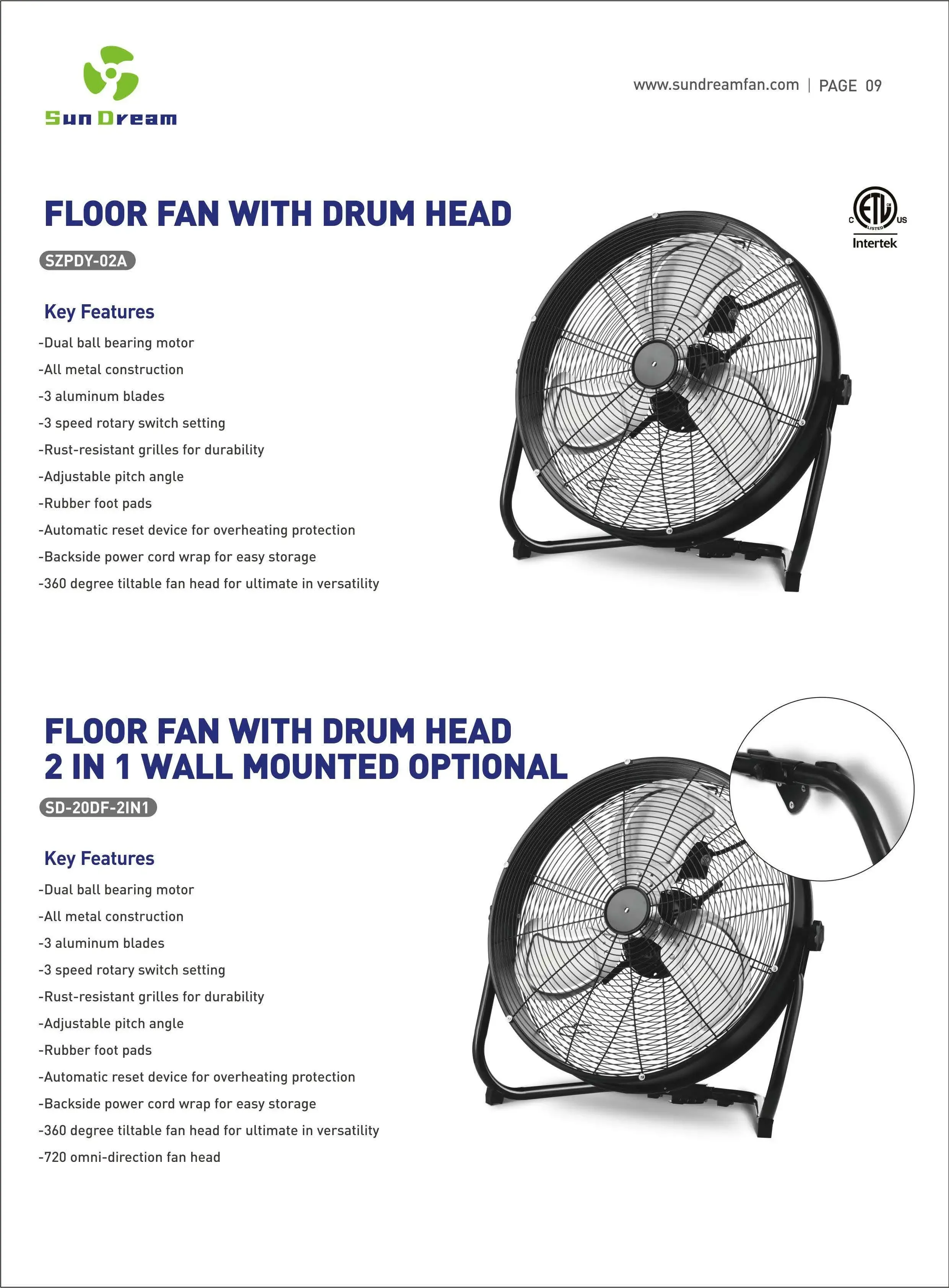
Two current models from our own line:
Model | Size | Key features |
SZPDY-02A | 18 / 20 inch | Dual ball bearing motor, all-metal construction, 3 aluminium blades, 3-speed rotary switch, rust-resistant grilles, adjustable pitch angle, rubber foot pads, automatic reset overheating protection, cord wrap, 360° tiltable head |
SD-20DF-2IN1 | 20 inch | Everything above, plus 720° omni-direction head and a 2-in-1 wall-mount option |
The 2-in-1 version is the one to specify where floor space is tight: it works as a floor fan with drum head, and the same head mounts on a wall bracket when the floor has to stay clear. In a small workshop that is often the difference between buying one fan and buying two.
2. Belt-drive drum fans, 24 to 48 inch
This is the type most buyers mean by drum fan, and the one that gets searched as a big fan on wheels. Metal body, wide barrel, castors, and a belt drive that puts the motor outside the airstream. These are large, high-air-speed industrial fans, and the width of the barrel is doing real work: it pressurises the airflow coming off the blades, so the air leaves more concentrated and reaches further than the blade size alone would suggest.
Sizes run from 24 to 48 inch. In practice the market splits into a 30 drum fan for a workshop bay, a 42 drum fan for a production hall, and drum fans 48 or 60 where the throw has to cross a whole floor — past 48 inches buyers usually search for a giant floor fan, and the purchase starts to be a building decision rather than a workshop one. A 24-inch unit is often searched as a 600mm drum fan in metric markets: same machine, one number apart, and worth covering in your product copy if you sell into both.
Model | Size | Power (low / high) | Air speed (high) | RPM (low / high) | Product (cm) | Carton (cm) | N.W. / G.W. (kg) | 20GP / 40GP / 40HC |
SD-42BDF | 42 inch | 450 / 550 W | 7.8 m/s | 470 / 530 | 113 × 50 × 118 | 115 × 30 × 119 | 31.8 / 34 | 69 / 139 / 159 |
SD-48BDF | 48 inch | 480 / 600 W | 7.0 m/s | 450 / 500 | 128 × 60 × 134 | 130 × 34 × 133 | 42.6 / 46 | 45 / 81 / 107 |
Both are four-blade aluminium propellers on a lifetime-lubricated belt, with a rocker switch for hi–lo, rust-resistant grilles, rubber wheels and a pull handle, and they ship assembled or knocked down to save container space. That last point is not a detail. A 48-inch drum fan is 128 cm across and weighs 46 kg gross, so how it packs decides your freight per unit — 107 to a 40HC knocked down, and the carton dimensions in the table are what you cost the container with.
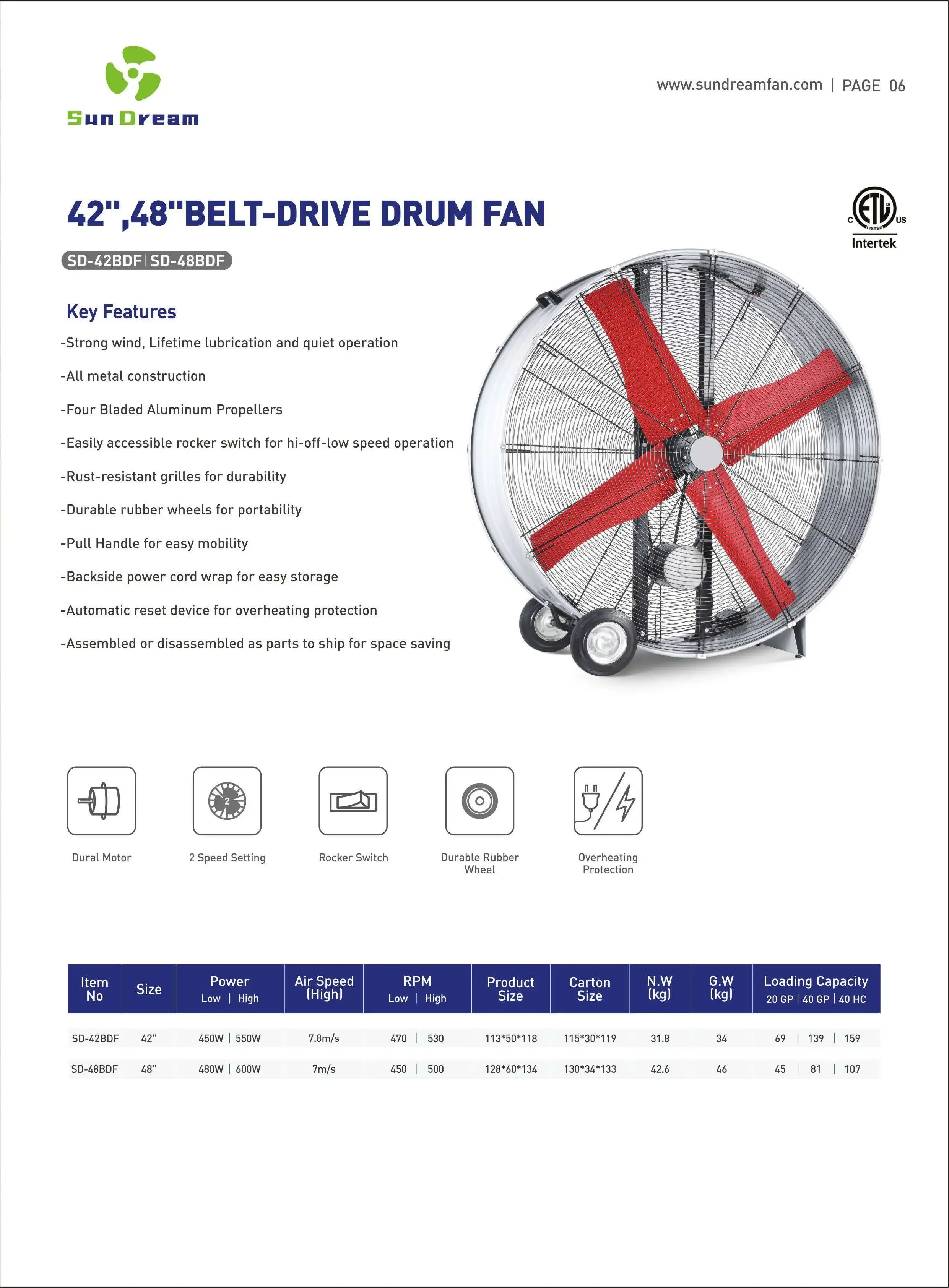
The industrial drum fan range covers this belt-drive family. Belt or direct drive is the next decision, because it changes both the price and where the fan can be used.
Belt drive versus direct drive. A belt-drive drum fan turns a large blade at 450–530 rpm with the motor sitting outside the airstream, so the motor stays cool and the fan runs all day without complaint. A direct-drive unit couples the blade straight to the motor, which is cheaper, lighter, and fine for intermittent use — the 20-inch floor and pedestal models in this guide are direct drive. If a customer asks for a direct-drive 30-inch unit, that is a legitimate specification, and it is usually sold as a high velocity floor fan rather than as a drum fan.
3. Drum pedestal fan
Add a column and a base to the drum head and you get a drum pedestal fan — in the trade, a floor standing fan with a barrel head — which raises the air to working height. This is the type for a packing line, a workstation, or anywhere people stand rather than walk, and it is the reason a 20-inch drum head outsells a 24-inch barrel in a workshop full of benches.
Our 20-inch family, with 360° or 720° tilt:
Model | Size | Power (low / mid / high) | Air speed (high) | RPM (low / mid / high) | Product (cm) | Carton (cm) | N.W. / G.W. (kg) | 20GP / 40GP / 40HC |
SZLDY-02 | 20 inch | 94 / 120 / 140 W | 8.0 m/s | 860 / 1200 / 1360 | 61.2 × 49 × 158 | 58.2 × 24 × 59.3 | 12.96 / 14.3 | 359 / 735 / 864 |
SD-20PDF-720 | 20 inch | 96 / 120 / 140 W | 8.0 m/s | 860 / 1200 / 1360 | 69.5 × 49 × 163 | 63.5 × 25 × 63.5 | 13.9 / 15.4 | 270 / 552 / 660 |
SZLD-04 | 20 inch | 88 / 97 / 110 W | 7.8 m/s | 960 / 1160 / 1260 | 55.3 × 49 × 150 | 73 × 17.8 × 57.2 | 11.9 / 13 | 411 / 843 / 939 |
SZLD-01 | 18 inch | 84 / 93 / 100 W | 7.5 m/s | 960 / 1160 / 1260 | 50 × 50 × 144 | 65.7 × 17.5 × 51 | 7.2 / 8.3 | 452 / 936 / 1170 |
SZLD-03 | 18 inch | 84 / 93 / 100 W | 7.5 m/s | 960 / 1160 / 1260 | 49 × 49 × 150 | 65.7 × 17.5 × 51 | 11 / 12.2 | 452 / 936 / 1170 |
All five share the same bones: dual ball bearing motor, all-metal structure, 3 or 5 aluminium blades, rotary switch, 3 speeds, height-adjustable column, steel base, manual head-up-and-down, hinged guard for cleaning, and automatic reset overheating protection. The 720° version adds omni-direction adjustment, which is the one to sell where the fan serves a group of workstations rather than one.
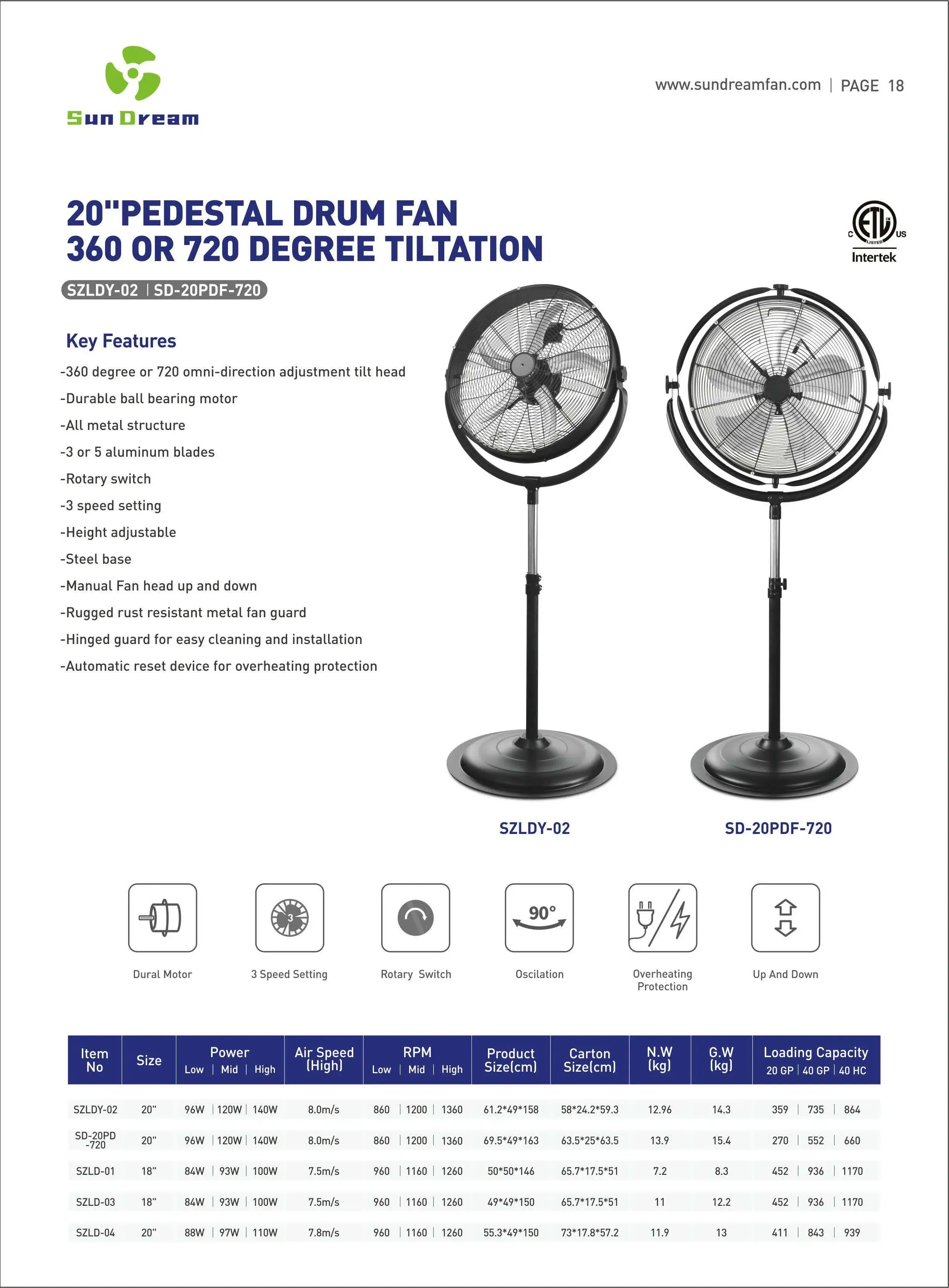
Read the container numbers, not just the wattage. SZLD-01 and SZLD-03 are both 18 inch and both load 1,170 per 40HC, but they differ in product depth and in net weight — which is why two models that look the same on a spec sheet can cost differently per landed unit. The pedestal fan range carries the rest of this family.
On price
Prices are not printed in a catalogue like this one, and that is deliberate: the same model quotes differently by voltage, plug standard, motor (copper or aluminium), blade count and carton configuration. What a catalogue can tell you honestly is the order of the ladder.
Tier | Models | What puts it there |
Entry | SZPDY-02A | Direct drive, thin barrel, 18–20 inch, lightest unit |
Entry+ | SD-20DF-2IN1 | Same, plus 720° head and wall-mount bracket |
Mid | SZLD-01 / SZLD-03 | 18 inch pedestal, column and base added |
Mid+ | SZLD-04 / SZLDY-02 / SD-20PDF-720 | 20 inch, higher wattage, heavier base |
Premium | SD-42BDF | 42 inch belt drive, 550 W, 34 kg |
Premium+ | SD-48BDF | 48 inch belt drive, 600 W, 46 kg, largest throw |
Give us a model number and a destination port and we will quote FOB against it. That is faster, and more accurate, than publishing a price that goes stale in a quarter.
Drum Fan vs Ordinary Floor Fan
Compare a drum fan against an ordinary floor fan and the difference comes down to three things: the motor, the body, and the wheels.
A drum fan is built as industrial equipment, so the motor is mainly a copper motor, the body is thicker, and it carries castors and a heavier counterweight. All three push the cost above an ordinary floor fan. What you get for it is airflow and stability: it pushes harder, and it stands still while it does it, where a light floor fan walks across the floor and rattles itself apart.
That is also the honest answer to the price objection. A cheap floor fan is a seasonal purchase that gets replaced; a heavy duty floor fan is equipment, and it is bought again only when the space changes. If your customer is weighing this against pedestal, wall-mounted or ceiling options instead, the types of heavy duty floor fan puts all of them side by side.
The Benefits of an Industrial Drum Fan
The purchase cost is higher than an ordinary floor fan. In service, the advantages are larger — in a big space, a high-performance industrial drum fan changes how the floor works.
- Fast cooling. The high-speed airflow drops the temperature in a warehouse, factory or other hot space quickly, and it does it in minutes rather than over an afternoon.
- Cleaner air. Dust, smoke and odour are blown away or filtered out, which makes the working environment healthier and safer.
- Faster drying. Wet floors in a livestock shed, on industrial equipment or in a shopping mall dry sooner, which prevents slips and accidents. Where drying is the main job, the same machine is sold as a floor blower fan, and the specification shifts to air speed at floor level.
- Energy efficiency. The air is concentrated on the area that needs it, so heat removal is efficient. Compared with cooling a whole building, that saves energy — and it is the argument that closes the sale against air conditioning.
- Cooler to the body. Concentrated airflow with a longer throw keeps workers comfortable across a large or crowded area.
For a buyer, the last two are the ones worth putting in front of the customer. The machine is not competing with air conditioning on temperature. It is competing with it on cost per square metre cooled, and it wins there.
How to Choose the Right Industrial Drum Fan for Your Space
Getting the choice right is what delivers the cooling, the drying and the air circulation. The right fan creates comfort, safety and efficiency across a wider area; the wrong one wastes power and wears itself out.
Space size
Start by measuring the area that needs ventilation. A small warehouse takes a small fan, such as a 16–18 inch drum fan; a large factory takes a high-power unit, such as a 48-inch oversized drum fan. Match the fan's airflow to the space rather than to the budget.
A high-performance industrial drum fan covers a large area, which keeps workers comfortable and the floor dry. The right size also prevents wasted energy and reduces motor load, so the fan actually finishes the job it was bought for. As a rule of thumb for a warehouse floor fan: one 42-inch unit per 150–250 m² of open floor with 4–6 m clearance, and one 48-inch unit where the ceiling is higher or the air has to travel further.
The fan's main function
Decide what you need the fan to do before you choose. If the job is drying a spill or a washed floor, you want high airflow plus horizontal adjustment of the air direction — the 20-inch floor drum fan with 720° omni-direction is the one for that, and it is the closest thing in this range to a true air mover. If you need the air delivered at height, you want a pedestal drum fan.
Many portable industrial drum fans tilt the drum up and down so the air can be aimed where it is needed. Being clear about the primary use is what keeps the fan efficient — cooling staff, drying floors, or ventilating a warehouse or a gym — and it is the question that decides the model before the price is even discussed.
Noise level and comfort
Noise decides comfort as much as airflow does, and how much it matters depends on where the fan is used. A quiet fan suits commercial space, gyms, event venues and offices; an industrial drum fan — a shop fan, in the language of the trade — suits factories and building sites, where air movement matters more than noise. Choose the balance between noise and power rather than maximising either. The belt-drive models are the quieter of the three types at the same airflow, because the blade turns slowly and the motor is out of the airstream.
Portability and safety
Portability means you can put the air where it is needed. Solid wheels and a handle make a 24-inch drum fan easy to move, which matters in a large workplace. Safety features — a guard grille, a stable base, a rigid frame — are what protect the worker while the fan runs, and on the belt-drive units the grille also keeps hands away from a belt that is not going to stop because someone reached in.
Voltage and plug
Different countries use different voltages and plugs. A fan for the United States needs 110 V and a US-standard plug. Before you order, ask the drum fan manufacturer whether the voltage and plug can be customised, and get the quotation on that basis — a fan that arrives with the wrong plug is a fan you cannot sell, and re-working it locally costs more than the freight did.
Budget
Weigh the type and the customisation against your budget, and weigh total cost of ownership alongside it. An aluminium-motor fan may cost less to buy than a copper-motor floor fan, but its TCO is not lower: the copper-motor industrial fan lasts longer, runs more stably, and is the one rated for 24-hour continuous duty. On a fan that runs every day, the cheaper motor is the more expensive decision — and on a fan that runs two hours a week, it is the correct one.
FAQ
Can the factory supply a copper-wire or aluminium-wire motor to order? Yes. If you are ordering in volume, you can ask for a copper-motor version. The two are built on the same line; the motor is the specification you are choosing, and it is also most of the price difference between two otherwise identical fans.
How do I import or wholesale drum fans from China? If you are a private buyer taking one or two small units, buy from Amazon — the landed cost will beat an import shipment. If you are ordering for a company or a warehouse, or customising for distribution, search for a Chinese fan manufacturer, or contact Sundream Fan directly, then pay the deposit and run the order. We are a Chinese industrial fan manufacturer and we build to order, so the specification is yours rather than the catalogue's.
What does your customisation process look like? We build to sample. Send us your drawing or your target specification and we will produce a sample for approval before the bulk run. That is the normal route for a private label, and it is cheaper than discovering a mismatch after a container has sailed.
What is the MOQ? Around 1,000 units, which is roughly a 20GP or 40HQ of fans. The exact number depends on size, because different fans load differently: a 16-inch pedestal fan runs 3,500–3,800 units per 40HQ, while a 20-inch drum fan is about 1,000. Container loading for every model in this guide is in the tables above, so you can cost a mixed container before you commit to it.
Where to Start
The three shapes answer three different questions. A floor fan with drum head is the entry SKU for spot cooling and drying. A 20-inch drum pedestal fan is the one that serves people standing at a line. A 42 or 48-inch belt-drive drum fan is the capital purchase for a whole floor, and it is where the margin is.
Tell us the space, the voltage and the port, and we will put the right model and the container loading against it.