Ceiling Fan
How to Choose a Range Hood: Specs, Price, 5 Models
Pick a range hood on four numbers: airflow, static pressure, full pressure efficiency and grease separation — five factory models compared by power and size.
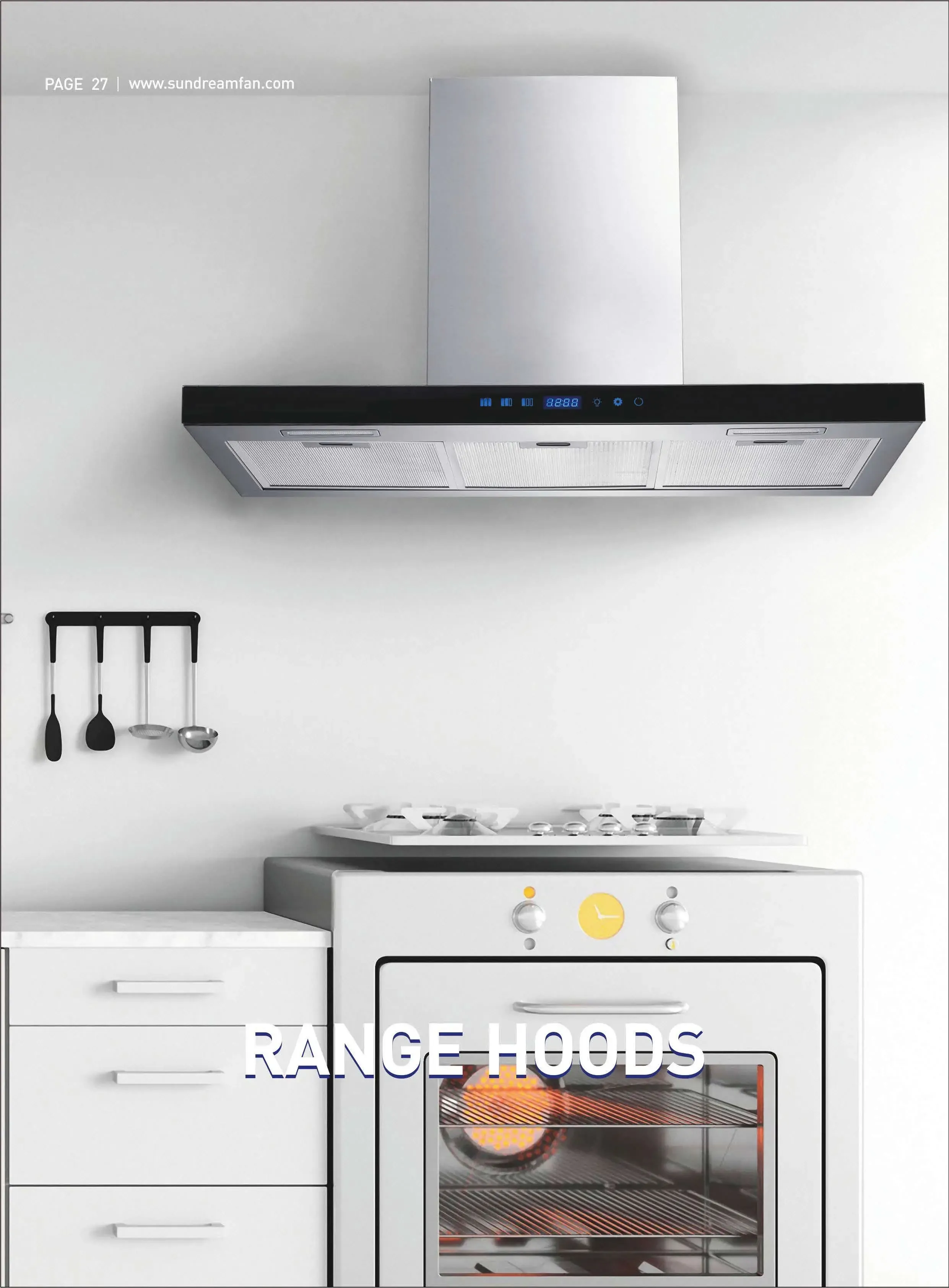
Quick answer: Choose a range hood on two things — suction and how easy it is to clean. Suction is decided by four numbers every manufacturer has to publish: airflow (17 m³/min is ordinary, 22–30 m³/min is high), static pressure (320 Pa is ordinary, 800 Pa and up is what a high-rise flat needs to stop smoke flowing back), full pressure efficiency (above 23% counts as high level) and grease separation degree (the higher the better). Cleaning is decided by grease separation, whether the hood self-cleans, and whether the surface is a non-stick material. Everything else — tempered glass, touch panels, brand name — is what makes one hood cost more than another. It is not what makes it work.
What Is a Range Hood and How Does It Work?
The kitchen is the soul of a home, and a good range hood is what keeps that kitchen clear. This guide starts from zero: what the machine is, where the price difference comes from, and how to pick one without paying for the wrong things.
The name changes by market. In the US it is a range hood or a vent hood; in the UK and Australia the same machine is a cooker hood, an extractor hood or a rangehood. The product is identical — only the search term is not, which is why the same factory catalogue gets read by buyers from four different countries.
Power the hood on and the motor drives the impeller at high speed. That creates negative pressure inside the hood, so smoke and fumes are drawn in and pushed out through the duct. Oil droplets condense under centrifugal force and run down into the oil collector, and that is how air and grease separate.
A range hood is made of a housing, an all-copper motor (the heart of the machine), an impeller, a volute, a smoke chamber, a check valve that stops smoke flowing back, an air guide plate, and the oil collection and drainage parts.
Home range hoods
Home hoods are built around instant strong suction, low noise and appearance. The three common layouts are top-mount (the European style), side-mount, and top-side dual suction. They suit everyday stir-fry at home, and they are also what you fit in an open kitchen where the hood is on show.
Commercial range hoods
Commercial hoods run a motor that is usually three times the power of a home unit, because they extract continuously and the fire requirements are higher. Restaurant back kitchens run heavy grease all day, and that is a different duty cycle from a home kitchen.
What Makes One Range Hood Cost More Than Another?
Four things, and only one of them is about suction.
Motor and specs. An inverter motor, high airflow of 22–30 m³/min, and high static pressure of 800 Pa or more for backflow protection in a high-rise building all cost more to build. They also give stronger suction, so this is money spent on performance.
Material and finish. Tempered glass, a nano anti-grease coating, and a fully flush ultra-thin body such as a 350 mm flush mount all improve how the hood looks and how easily it wipes clean.
Smart features and self-cleaning. Gesture control, hood-stove linkage, and a 110 °C steam wash or heat-melt wash. This is where most of the premium sits, because it removes the need to take the hood apart to clean it.
Brand and channel. A factory direct supplier such as Zhongshan Sundream cuts out the middleman, so the same specification costs less. That is the one line item on this list that does not change the product at all.
How to Choose a Range Hood: Suction and Cleaning
Two points matter most when buying for a home: strong suction, and easy cleaning.
Suction: read the four published numbers
Chinese households stir-fry, which throws a lot of smoke, and open kitchens have become more popular in recent years, so strong suction matters more than it used to. You judge suction from the hood's own published figures — the manufacturer has to state them — and from how big they are.
- Airflow. A normal range hood moves about 17 m³/min. The bigger the airflow, the stronger the suction.
- Static pressure. A normal hood is around 320 Pa. The higher the static pressure, the better it resists smoke flowing back down the duct, which also means stronger suction.
- Full pressure efficiency. In plain terms, how well the hood uses the motor's power. It is tied to energy consumption. Above 23% is already a high level on the market today.
- Grease separation degree. How completely the hood separates grease from the air. Higher is better: the higher it is, the less oil clings inside the hood, and the less that oil drags down suction and service life.
Test it in a showroom
The other half of judging suction is physical. Go to an offline experience store, watch the hood actually pull smoke, and listen to it running while you are there, so you know whether the noise is something you can live with.
Cleaning: the second half of the decision
A range hood solves the kitchen's smoke problem and then becomes a cleaning problem of its own. A hood that is hard to clean is a real nuisance, and how easy it is to clean depends on three things — not only on suction.
- Grease separation degree. A hood that separates grease to a high degree is easier to wash, so start here.
- Self-cleaning. The function is a little gimmicky, but it does reduce the trouble of cleaning the hood yourself.
- Material. If the hood uses a non-stick material, the difficulty of cleaning drops a lot.
The Five Models a Range Hood Factory Actually Wholesales
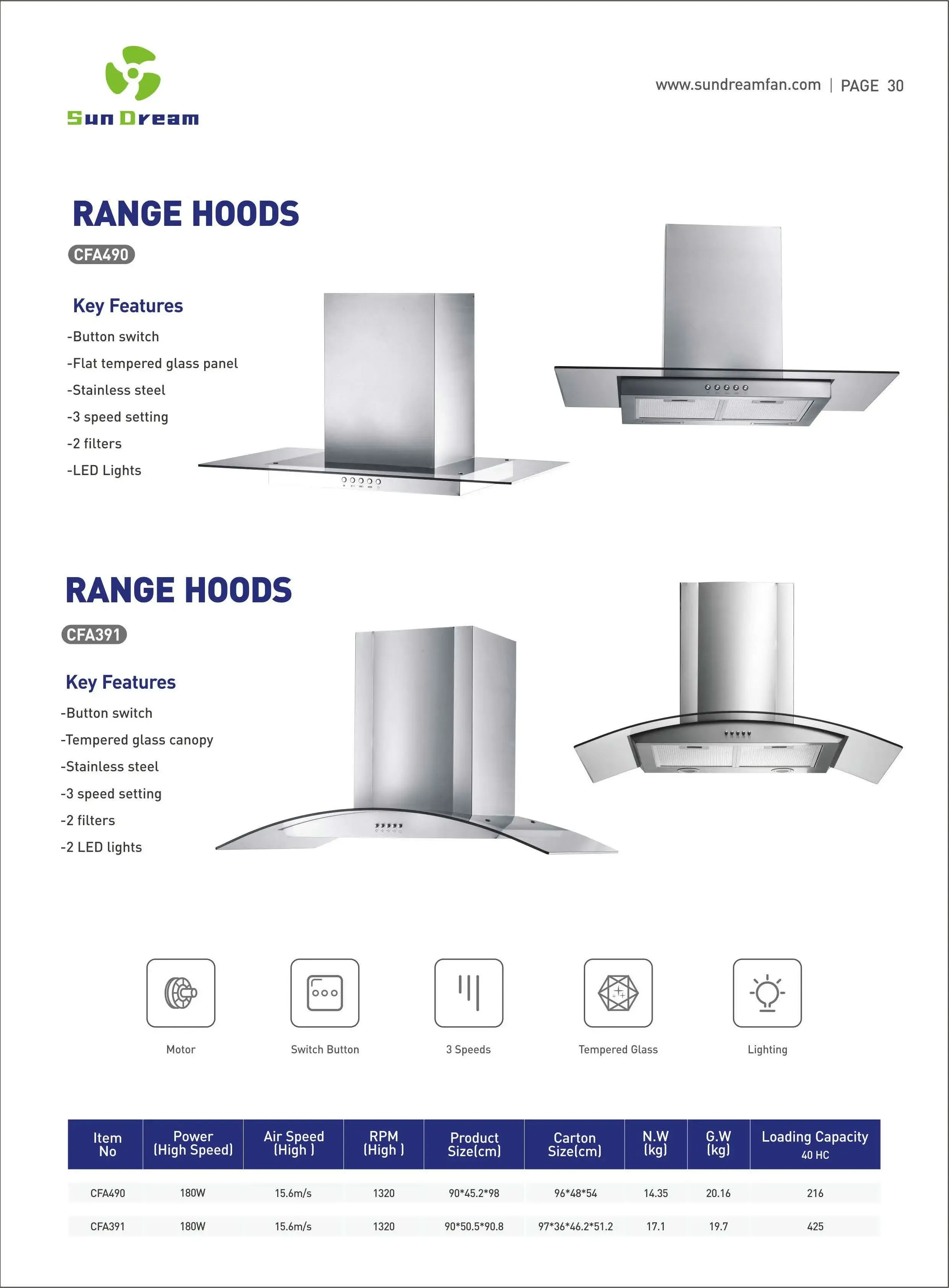
Our current range is five models — CFA290, CFA362, CFA391, CFA490 and CFA690 — and all five are best sellers. The data below is from our own catalogue.
Model | Layout and features | Power (high) | Air speed (high) | RPM | Unit size (cm) | Carton (cm) | N.W. / G.W. (kg) | 40'HQ |
CFA290 | Wall-mounted chimney, stainless steel, 3-speed button, 3 filters, LED, economic style | 75 W | 10.9 m/s | 1420 | 90 × 44.5 × 100 | 95.5 × 26 × 47.2 | 7.6 / 9.4 | 554 |
CFA362 | Curved tempered glass canopy, blue LED touch, time display, 3-speed, 1 filter, 2 LED lights | 180 W | 15.6 m/s | 1320 | 60 × 50.5 × 86.5 | 65.5 × 39 × 42.2 × 51.3 | 14.9 / 17.2 | 570 |
CFA391 | Curved tempered glass canopy, button switch, stainless steel, 3-speed, 2 filters, 2 LED lights | 180 W | 15.6 m/s | 1320 | 90 × 50.5 × 90.8 | 97 × 36 × 46.2 × 51.2 | 17.1 / 19.7 | 425 |
CFA490 | Flat tempered glass panel, button switch, stainless steel, 3-speed, 2 filters, LED lights | 180 W | 15.6 m/s | 1320 | 90 × 45.2 × 98 | 96 × 48 × 54 | 14.35 / 20.16 | 216 |
CFA690 | Flat tempered glass panel, blue LED touch, time display, stainless steel, 3-speed, 3 filters, LED lights | 180 W | 15.6 m/s | 1320 | 90 × 50.5 × 88.5 | 101.7 × 37.2 × 42 × 51.5 | 17 / 19.2 | 400 |
Two notes on reading the table.
Air speed is not airflow. The catalogue gives air speed at the outlet in m/s, which is what you can measure and what decides how hard the smoke is pushed. Convert it if you need m³/min: at a 150 mm outlet the area is 0.0177 m², so 15.6 m/s comes out at roughly 16.5 m³/min — right on the 17 m³/min ordinary baseline above. CFA290, at 10.9 m/s, works out around 11.6 m³/min, which is the honest number for a 75 W economic model. Actual rated airflow depends on the duct size you install.
Carton size with four figures means a two-carton pack: body in one carton, chimney flue in the other. That matters for warehouse space and for how you quote freight.
How to pick between them. CFA290 is the economic chimney range hood — the classic wall mount range hood shape, in stainless steel with a heightened decorative hoarding. It has the lowest power, the lowest weight, and the second-highest container loading of the five at 554 units per 40'HQ, so it is the volume model for price-driven markets. CFA362 is the only 60 cm unit, which makes it the one for small kitchens and for anyone worried about banging their head on the hood; it also loads the most, at 570. CFA391 and CFA690 are both 90 cm and 180 W, and the difference is curved glass with buttons against flat glass with a touch screen and time display — CFA690 is the fuller spec of the two, with three filters instead of two. CFA490 is the 90 cm flat-glass button model, and at 216 units per 40'HQ it is the one that packs worst — worth knowing before you plan a mixed container.
Customer Cases
Case 1. Mr Li, a homeowner doing up a small flat himself, was afraid of bumping his head on the hood, so he chose the CFA362. His feedback afterwards: the size is just right, the suction is strong enough, the gesture switch is convenient, and the price is a good deal lower than buying offline — factory direct is reliable.
Case 2. A customer of another brand tested range hoods with us, then ordered a large batch, and we printed their logo on the machines. That is the normal shape of an OEM order: sample first, then volume, then branding.
FAQ
Do I need 22–30 m³/min, or is 17 m³/min enough? 17 m³/min is the ordinary level and it handles normal home cooking. Go up to 22–30 m³/min if you stir-fry hard and often, or if the kitchen is open to the living area. Higher airflow also needs a bigger duct to be worth paying for.
Do I really need 800 Pa static pressure? Only if the flue run is long or you are high up in a building, where the shared duct pressure pushes smoke back into your kitchen. A single-storey house with a short direct duct does not need it. 320 Pa is the ordinary level and it is enough there.
Is self-cleaning worth the premium? Partly. It is a little gimmicky, but it does cut how often you take the hood apart, and on a hood that is otherwise hard to clean that is worth something. If you are choosing between paying for self-cleaning and paying for a higher grease separation degree, take the grease separation degree first — it solves the cause, not the symptom.
60 cm or 90 cm?
Match the hood to the hob, not to the wall. A 60 cm hood over a 60 cm hob is correct; a 90 cm hood over a 90 cm hob is correct. Going wider than the hob buys a little more capture area and costs a lot more in container space — CFA362 loads 570 per 40'HQ, CFA490 only 216.
Choosing Between Suction and Price
Suction and cleaning are the two things worth paying for; glass, touch panels and brand are what you pay extra for. If you are buying for a price-driven market, CFA290 at 75 W and 554 units per 40'HQ does that job. If you are buying for a market that reads the spec sheet, the 180 W 90 cm models are the ones to lead with, and the four numbers in this guide are how your customer will judge them.
We build range hoods and ventilation equipment in Zhongshan, and we ship both our own models and OEM orders with the buyer's logo. If you want to see how the rest of the range is specified, the rest of our guides cover the ventilation side, and you can ask us directly about samples, MOQ and lead time.