Oct 5, 2026Floor fan
HVLS vs Floor Fans: Why Factories Still Use Floor Fans with HVLS Systems
Discover why factories still use floor fans alongside HVLS systems. Learn the 8 key reasons, key differences, and the best hybrid cooling strategy for large warehouses.
HVLS vs Floor Fans: Why Factories Still Use Floor Fans with HVLS Systems
Introduction
HVLS systems are often called the ultimate solution for large-space ventilation. But walk into many factories, and you will still see floor fans or industrial pedestal fans on the ground.
The core answer is that HVLS and floor fans are not substitutes—they are complementary. HVLS handles overall air circulation, while floor fans deliver high-velocity, localized cooling. Together, they create a better ventilation and cooling effect.
This article explains 8 reasons why factories still use floor fans and provides a hybrid HVLS + floor fan cooling strategy.
In hot weather, HVLS fan systems for factories or traditional ceiling fans are highly effective for large-space cooling and air delivery, which is why they are called the ultimate solution for large-area ventilation. They offer low energy consumption, low noise, and a comfortable perceived temperature. However, in many factories, high-velocity floor fans are still pointed at warehouses or workshops. Why not simply eliminate industrial floor fans to save costs and switch entirely to industrial ceiling fans?
This article explains why factories still use industrial floor fans and introduces specific application scenarios to help you make the best choice.
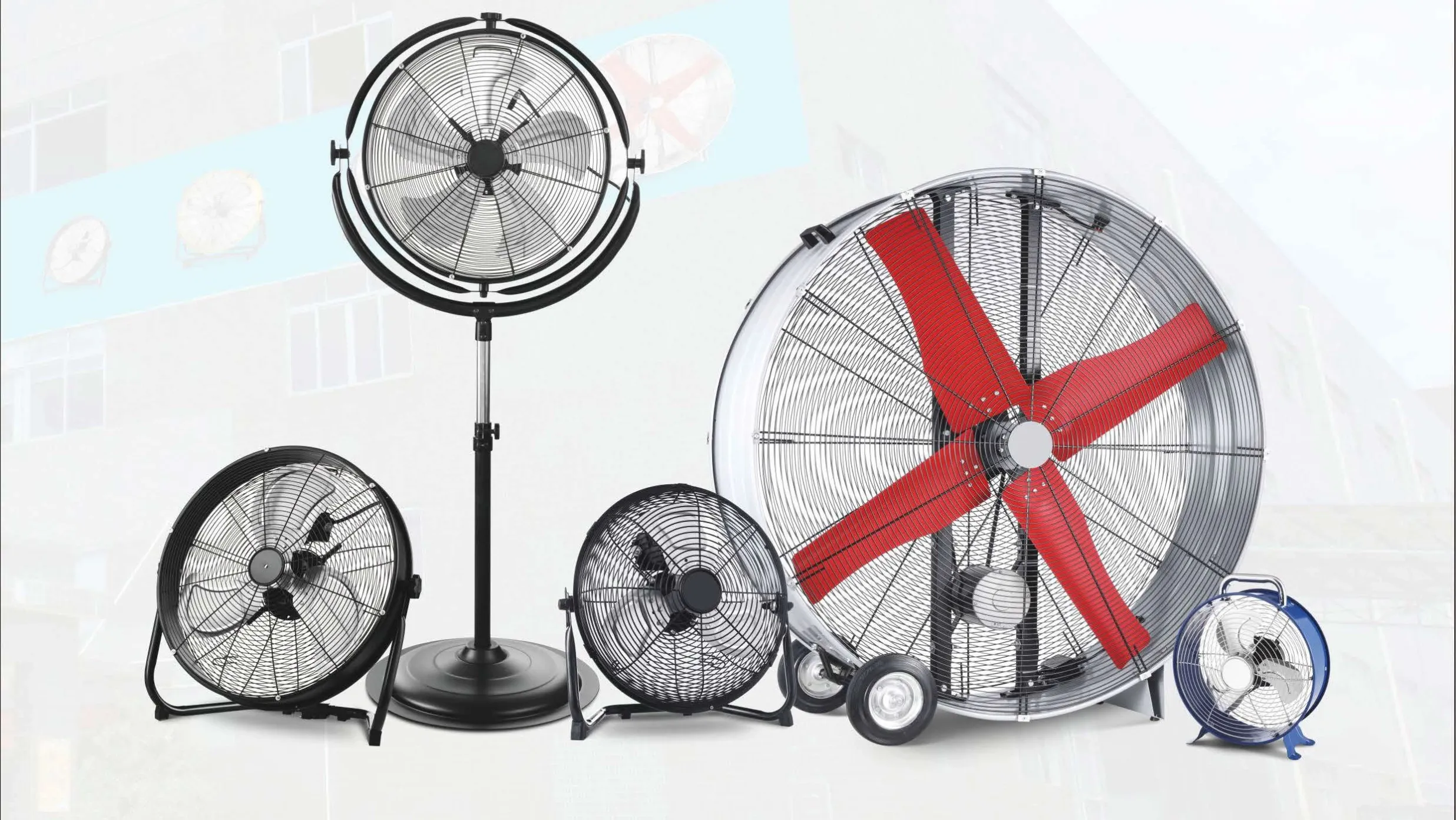
Quick Answer: Why Use Floor Fans with HVLS?
Factories still use floor fans because HVLS systems provide gentle, large-area airflow, while floor fans deliver high-velocity, targeted cooling. HVLS cannot eliminate hot spots, dead zones, or individual workstation discomfort. Industrial floor fans are also cheaper, portable, and easier to deploy in rented or temporary spaces.
HVLS and floor fans are not substitutes—they are complementary. HVLS handles overall air circulation, while floor fans handle localized high-speed cooling. The two work together to create better ventilation and cooling results.
What Is an HVLS System?
In summer, steel-structure production plants with ceilings over 8 meters often suffer from extreme heat. After the roof is exposed to the sun, temperatures can exceed 60°C. Hot air accumulates over time, forming a heat dome, while the ground-level work area becomes stuffy and oxygen-deficient. Many enterprises try to purchase equipment piece by piece but still cannot break the problems of heat stratification and high energy consumption. Industrial ceiling fans, relying on high-volume, low-speed technology, have become the most cost-effective core equipment for ventilation and cooling in tall factories.
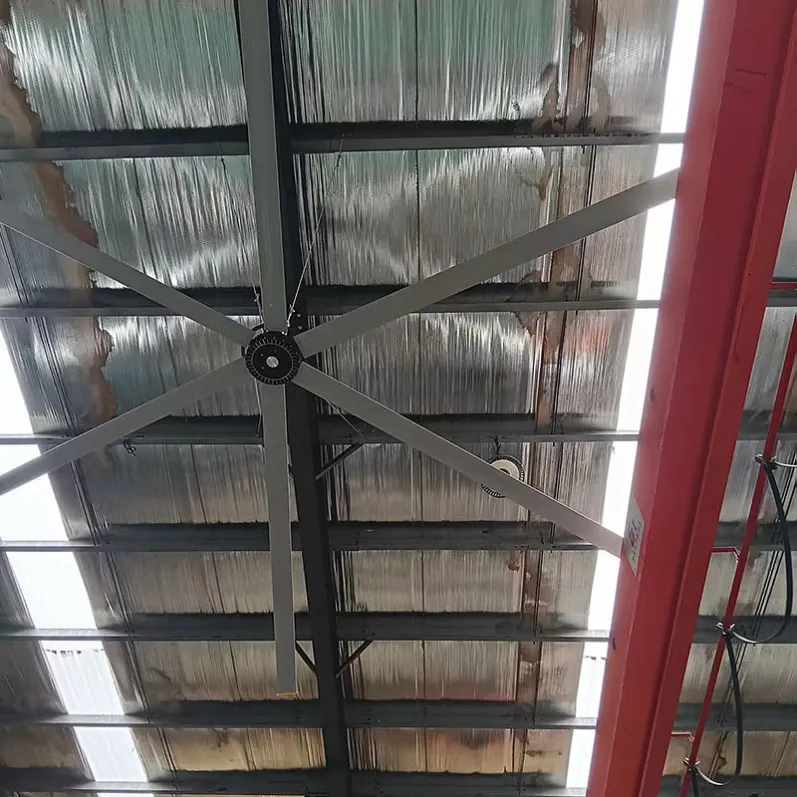
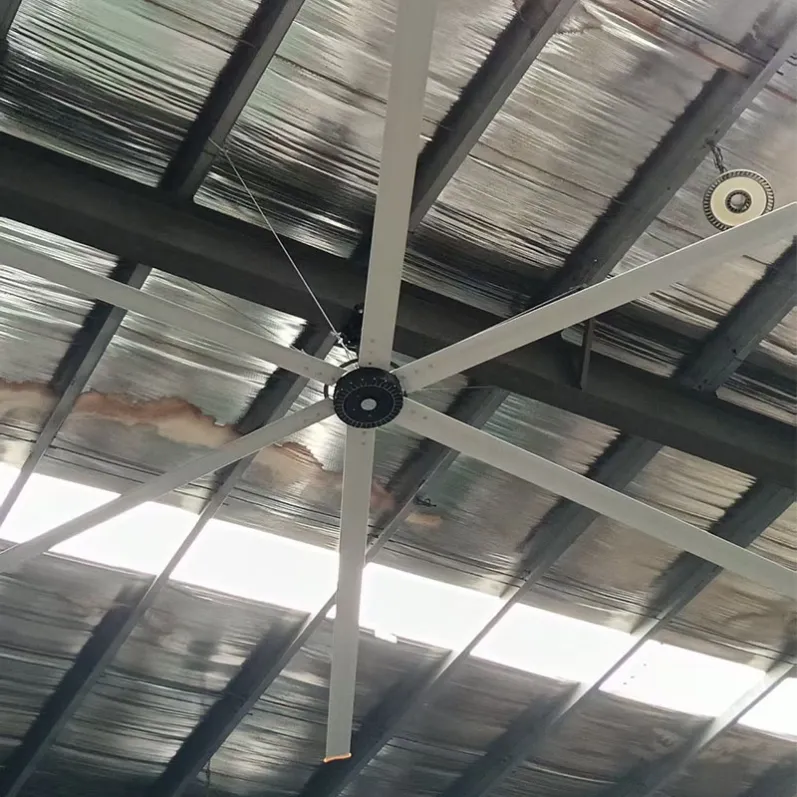
- HVLS = High Volume Low Speed. An HVLS fan is a large industrial ceiling fan with high airflow and low speed. It is not just simple air delivery—it cleverly uses aerodynamics to mix external and internal air, resulting in noticeable cooling.
- Features: Large diameter, low speed, wide coverage, gentle airflow, relatively low energy consumption.
- Advantages: Overall air mixing, reduced stratification, energy savings, suitable for large spaces.
- Limitations: Low air speed, difficult to reach workstations directly; blocked by racks, equipment, and partitions, leaving dead zones; not flexible, high installation cost.
What Counts as a Floor Fan in a Factory?
Tall steel-structure factories and assembly line workshops suffer from serious heat accumulation. In summer, indoor temperatures are high, air circulation is poor, and local workstations are exposed to concentrated heat. Traditional fixed industrial ceiling fans require drilling and welding, while mobile floor fans require no installation and are low-cost. These reasons make floor fans in factories an evergreen solution.
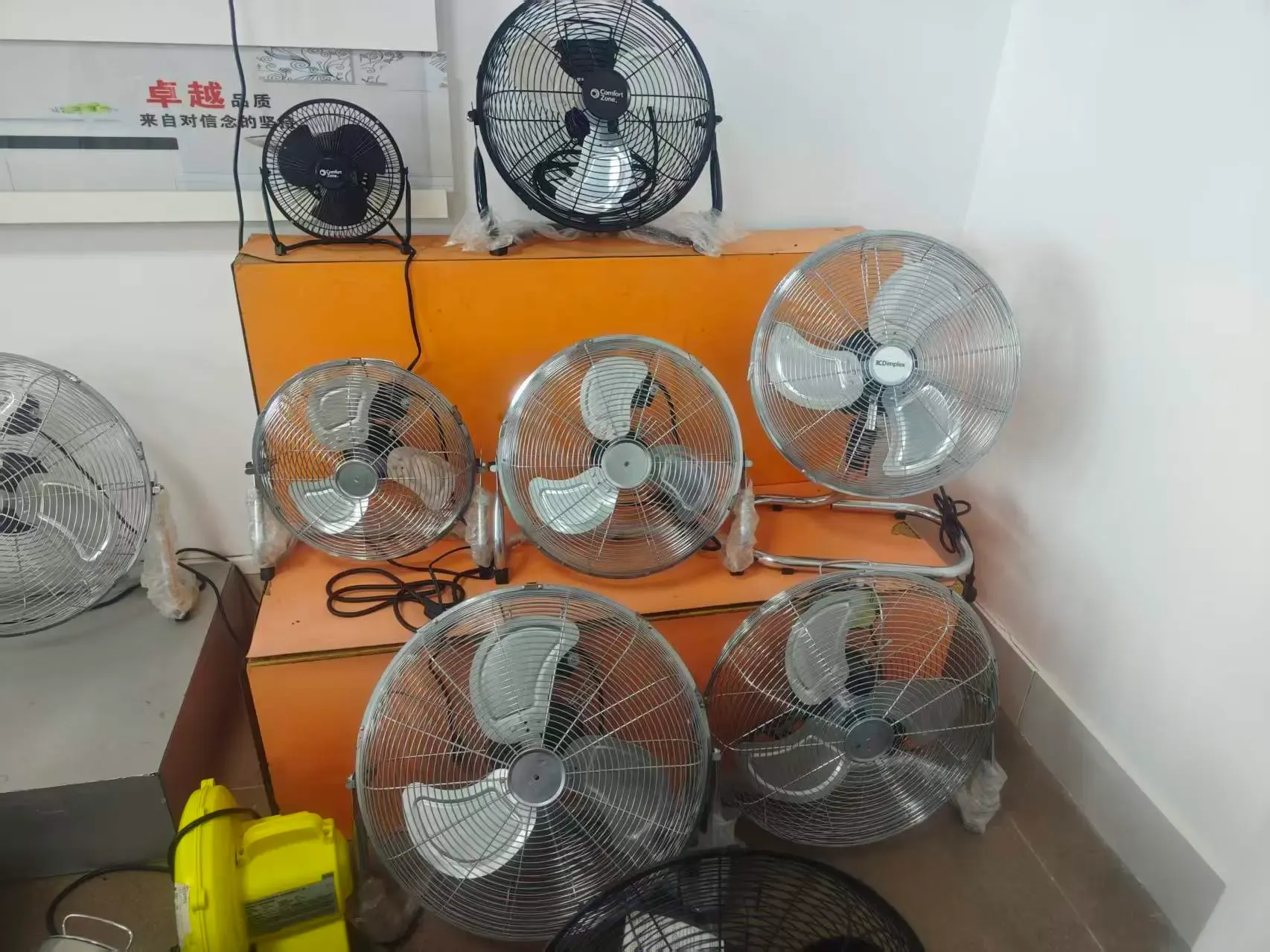
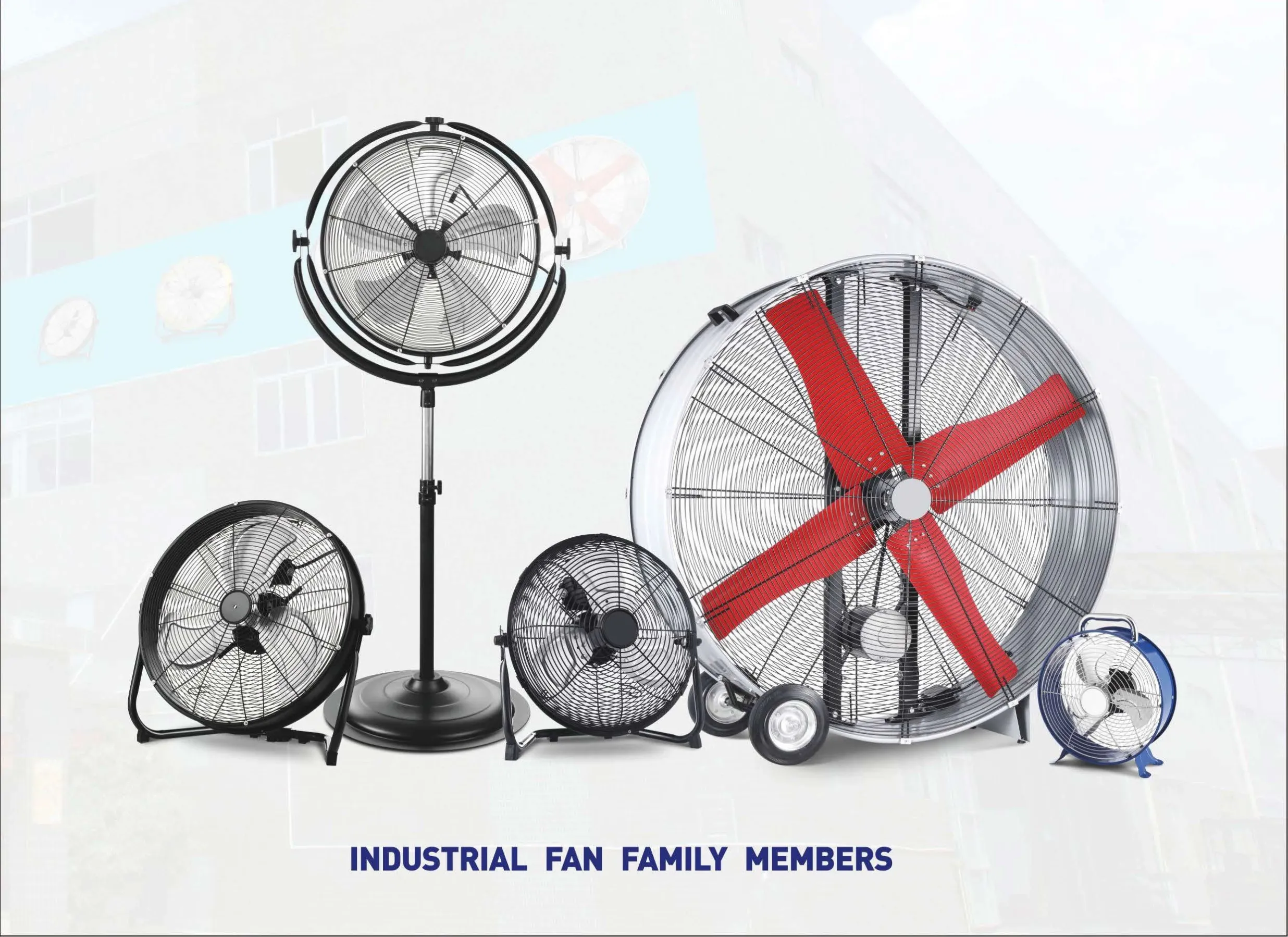
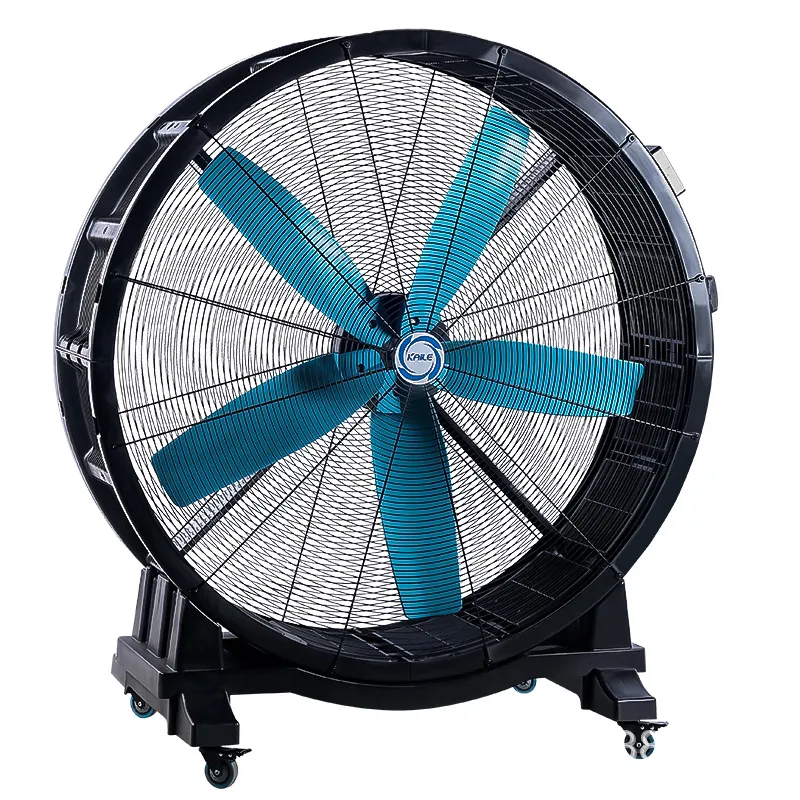
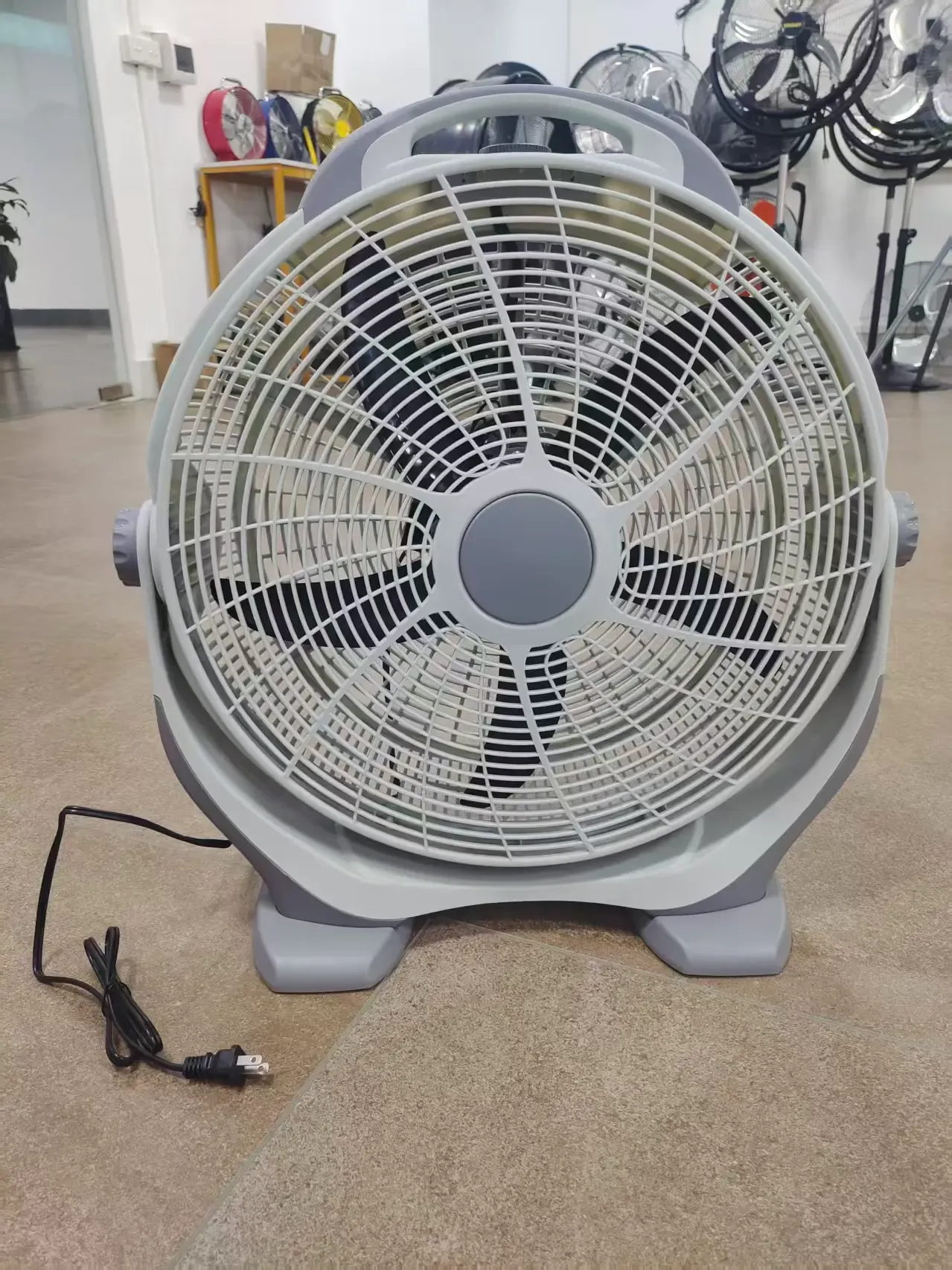
- An industrial floor fan is a very common ventilation and cooling device. It can be equipped with a power cord, handle, and wheels for easy movement, offering flexibility and portability. Compared with industrial ceiling fans, floor fans have higher air speed and can target specific areas for cooling.
- Features: High-speed airflow, movable, plug-and-play, strong localized cooling.
- Common scenarios: Workstations, aisles, loading areas, temporary zones, near heat sources.
Industrial fans have a very wide range of applications. In machining workshops, assembly lines, and packaging workshops, they can be positioned to direct air at high-heat workstations such as welding and grinding. In large logistics warehouses and raw material storage areas, they circulate air, reduce heat accumulation, and lower the risk of moisture and mold on goods. In sports venues such as badminton halls and gymnasiums, they serve as temporary auxiliary ventilation equipment to quickly improve stuffy conditions before and after events. For temporary processing areas on construction sites, outdoor exhibitions, and temporary production sites, they are the first choice for short-term ventilation and cooling. They are also suitable for large spaces such as farms and farmers' markets. They require no damage to existing building structures, flexibly handle temporary and changing ventilation needs, and one machine can be rotated across multiple areas, greatly reducing ventilation renovation budgets.
8 Reasons Factories Still Use Floor Fans Despite HVLS
Here are 8 reasons why factories use a combination of industrial ceiling fans and floor fans:
1. Spot Cooling for Individual Workstations
HVLS fans provide overall cooling and air circulation, while floor fans can blow directly at workstations for a more noticeable perceived temperature drop. If only HVLS fans are used, the cooling and ventilation effect may not meet expectations. If only floor fans are used, the budget will be higher. By combining both, factories can balance purchase cost, energy consumption, and the desired ventilation and cooling effect.
2. HVLS Airflow Is Gentle, Not High-Velocity
The main characteristic of HVLS fans is low air speed, determined by the structural properties of ceiling fans. Blades up to 7.3 meters long can provide a larger air delivery and cooling range, tending toward overall cooling. In summer, overall cooling is essential in high-temperature, high-humidity factory environments, but the ventilation and cooling effect may not meet requirements, and workers may still feel hot. Adding industrial floor fans provides concentrated high-speed airflow for rapid cooling and ventilation.
3. Dead Zones and Rack Obstruction
Although industrial ceiling fans can provide overall ventilation and cooling, in actual factory environments, many obstacles such as racks, machines, and partitions block HVLS airflow, causing heat accumulation in certain areas. Floor fans or pedestal fans can deliver air to these areas. When there is no power cord temporarily, battery-powered floor fans can even be used for localized cooling.
4. Lower Upfront Cost and Flexible Deployment
HVLS fans have high purchase and installation costs. Floor fans have a low unit price and can be added after installing industrial ceiling fans as a supplement for ventilation and cooling. Compared with industrial air conditioning, the purchase cost, maintenance cost, and energy consumption of HVLS fans + floor fans are lower, achieving energy savings, emission reduction, and cost reduction.
5. Mobility for Changing Layouts and Temporary Zones
Industrial mobile floor fans are highly flexible, requiring no installation and offering plug-and-play operation. They are more suitable for open areas such as rented factories, temporary production lines, maintenance areas, and loading areas.
6. Backup During HVLS Maintenance or Power Issues
When HVLS is down for maintenance or repair, large industrial floor fans can maintain basic ventilation and cooling. They serve not only as a supplement but also as backup ventilation and cooling equipment.
7. Worker Preference and Perceived Comfort
Industrial floor fans have higher air speed and stronger airflow, suitable for removing heat and humidity at specific points. Workers prefer perceptible strong airflow, and floor fans provide higher psychological comfort.
8. Local Heat Sources and Equipment Cooling
Floor fans can deliver high-intensity airflow to heat sources, significantly reducing the surrounding temperature by lowering the temperature of the heat source itself. Local heat sources such as welding, furnaces, compressors, and motors require directed high-speed airflow.
HVLS vs. Floor Fans: Key Differences
Comparison Dimension | HVLS System | Industrial Floor Fan / Pedestal Fan |
|---|---|---|
Airflow Type | Large-area, low-speed | Localized, high-speed |
Coverage | Whole space | Workstation / aisle / heat source |
Installation | Ceiling mounted | Plug-and-play |
Fan Price | High | Low |
Portability | Fixed | Movable |
Application | Overall ventilation, energy saving | Spot cooling, dead zones, temporary areas |
Noise | Low | Medium to high |
Maintenance | Professional maintenance | Simple |
Suitable Scenario | Large open factories | Local high heat, workstations, warehouse aisles |
When Should Factories Use HVLS, Floor Fans, or Both?
HVLS ceiling fans and floor fans each have their own advantages and characteristics, so their application scenarios differ. You need to evaluate the overall factory layout, climate, and other factors to determine your ventilation and cooling strategy.
- HVLS Only: Large open spaces, overall ventilation, energy-saving priority.
- Floor Fans Only: Small areas, rented factories, temporary workstations, local heat sources.
- HVLS + Floor Fans Hybrid: The optimal solution. HVLS handles basic air circulation, while floor fans handle spot cooling.
- You can add a "hybrid cooling strategy matrix."
FAQ
1. Do HVLS fans replace floor fans?
No. Floor fans can be used not only for industrial area cooling but also as home appliances. Their low price, high airflow, flexibility, and portability make them an irreplaceable ventilation and cooling device.
2. Are floor fans more energy-efficient than HVLS?
No. The energy consumption of the asynchronous motor with gearbox in a floor fan is higher than the permanent magnet motor in an HVLS fan, so floor fans consume more electricity.
3. How many floor fans do I need in a factory?
A small factory may need about 20-50 units. However, the cost of purchasing multiple floor fans or pedestal fans could instead buy several industrial ceiling fans with money left over. Overall, purchasing large ceiling fans is more cost-effective and energy-efficient.
Conclusion
In industrial ventilation, HVLS and floor fans are not an either-or choice—they are complementary.
- Best Strategy: HVLS handles overall air circulation, while floor fans handle localized spot cooling.
- Purchasing Advice: First evaluate heat sources, workstations, and spatial layout, then decide on a hybrid solution.
We are a professional fan manufacturer. Our main products include floor fans, pedestal fans, industrial ceiling fans, negative pressure fans, blowers, and kitchen air coolers. We also provide one-stop cooling and ventilation solutions.
Meta Description
Discover why factories still use floor fans alongside HVLS systems. Learn the 8 key reasons, key differences, and the best hybrid cooling strategy for large warehouses.
HVLS vs Floor Fans: Why Factories Still Use Floor Fans with HVLS Systems
Introduction
HVLS systems are often called the ultimate solution for large-space ventilation. But walk into many factories, and you will still see floor fans or industrial pedestal fans on the ground.
This raises a paradox: if HVLS already covers the entire facility, why are floor fans still needed?
The core answer is that HVLS and floor fans are not substitutes—they are complementary. HVLS handles overall air circulation, while floor fans deliver high-velocity, localized cooling. Together, they create a better ventilation and cooling effect.
This article explains 8 reasons why factories still use floor fans and provides a hybrid HVLS + floor fan cooling strategy.
In hot weather, HVLS fan systems for factories or traditional ceiling fans are highly effective for large-space cooling and air delivery, which is why they are called the ultimate solution for large-area ventilation. They offer low energy consumption, low noise, and a comfortable perceived temperature. However, in many factories, high-velocity floor fans are still pointed at warehouses or workshops. Why not simply eliminate industrial floor fans to save costs and switch entirely to industrial ceiling fans?
This article explains why factories still use industrial floor fans and introduces specific application scenarios to help you make the best choice.
Quick Answer: Why Use Floor Fans with HVLS?
Factories still use floor fans because HVLS systems provide gentle, large-area airflow, while floor fans deliver high-velocity, targeted cooling. HVLS cannot eliminate hot spots, dead zones, or individual workstation discomfort. Industrial floor fans are also cheaper, portable, and easier to deploy in rented or temporary spaces.
HVLS and floor fans are not substitutes—they are complementary. HVLS handles overall air circulation, while floor fans handle localized high-speed cooling. The two work together to create better ventilation and cooling results.
What Is an HVLS System?
In summer, steel-structure production plants with ceilings over 8 meters often suffer from extreme heat. After the roof is exposed to the sun, temperatures can exceed 60°C. Hot air accumulates over time, forming a heat dome, while the ground-level work area becomes stuffy and oxygen-deficient. Many enterprises try to purchase equipment piece by piece but still cannot break the problems of heat stratification and high energy consumption. Industrial ceiling fans, relying on high-volume, low-speed technology, have become the most cost-effective core equipment for ventilation and cooling in tall factories.
- HVLS = High Volume Low Speed. An HVLS fan is a large industrial ceiling fan with high airflow and low speed. It is not just simple air delivery—it cleverly uses aerodynamics to mix external and internal air, resulting in noticeable cooling.
- Features: Large diameter, low speed, wide coverage, gentle airflow, relatively low energy consumption.
- Advantages: Overall air mixing, reduced stratification, energy savings, suitable for large spaces.
- Limitations: Low air speed, difficult to reach workstations directly; blocked by racks, equipment, and partitions, leaving dead zones; not flexible, high installation cost.
What Counts as a Floor Fan in a Factory?
Tall steel-structure factories and assembly line workshops suffer from serious heat accumulation. In summer, indoor temperatures are high, air circulation is poor, and local workstations are exposed to concentrated heat. Traditional fixed industrial ceiling fans require drilling and welding, while mobile floor fans require no installation and are low-cost. These reasons make floor fans in factories an evergreen solution.
- An industrial floor fan is a very common ventilation and cooling device. It can be equipped with a power cord, handle, and wheels for easy movement, offering flexibility and portability. Compared with industrial ceiling fans, floor fans have higher air speed and can target specific areas for cooling.
- Features: High-speed airflow, movable, plug-and-play, strong localized cooling.
- Common scenarios: Workstations, aisles, loading areas, temporary zones, near heat sources.
Industrial fans have a very wide range of applications. In machining workshops, assembly lines, and packaging workshops, they can be positioned to direct air at high-heat workstations such as welding and grinding. In large logistics warehouses and raw material storage areas, they circulate air, reduce heat accumulation, and lower the risk of moisture and mold on goods. In sports venues such as badminton halls and gymnasiums, they serve as temporary auxiliary ventilation equipment to quickly improve stuffy conditions before and after events. For temporary processing areas on construction sites, outdoor exhibitions, and temporary production sites, they are the first choice for short-term ventilation and cooling. They are also suitable for large spaces such as farms and farmers' markets. They require no damage to existing building structures, flexibly handle temporary and changing ventilation needs, and one machine can be rotated across multiple areas, greatly reducing ventilation renovation budgets.
8 Reasons Factories Still Use Floor Fans Despite HVLS
Here are 8 reasons why factories use a combination of industrial ceiling fans and floor fans:
1. Spot Cooling for Individual Workstations
HVLS fans provide overall cooling and air circulation, while floor fans can blow directly at workstations for a more noticeable perceived temperature drop. If only HVLS fans are used, the cooling and ventilation effect may not meet expectations. If only floor fans are used, the budget will be higher. By combining both, factories can balance purchase cost, energy consumption, and the desired ventilation and cooling effect.
2. HVLS Airflow Is Gentle, Not High-Velocity
The main characteristic of HVLS fans is low air speed, determined by the structural properties of ceiling fans. Blades up to 7.3 meters long can provide a larger air delivery and cooling range, tending toward overall cooling. In summer, overall cooling is essential in high-temperature, high-humidity factory environments, but the ventilation and cooling effect may not meet requirements, and workers may still feel hot. Adding industrial floor fans provides concentrated high-speed airflow for rapid cooling and ventilation.
3. Dead Zones and Rack Obstruction
Although industrial ceiling fans can provide overall ventilation and cooling, in actual factory environments, many obstacles such as racks, machines, and partitions block HVLS airflow, causing heat accumulation in certain areas. Floor fans or pedestal fans can deliver air to these areas. When there is no power cord temporarily, battery-powered floor fans can even be used for localized cooling.
4. Lower Upfront Cost and Flexible Deployment
HVLS fans have high purchase and installation costs. Floor fans have a low unit price and can be added after installing industrial ceiling fans as a supplement for ventilation and cooling. Compared with industrial air conditioning, the purchase cost, maintenance cost, and energy consumption of HVLS fans + floor fans are lower, achieving energy savings, emission reduction, and cost reduction.
5. Mobility for Changing Layouts and Temporary Zones
Industrial mobile floor fans are highly flexible, requiring no installation and offering plug-and-play operation. They are more suitable for open areas such as rented factories, temporary production lines, maintenance areas, and loading areas.
6. Backup During HVLS Maintenance or Power Issues
When HVLS is down for maintenance or repair, large industrial floor fans can maintain basic ventilation and cooling. They serve not only as a supplement but also as backup ventilation and cooling equipment.
7. Worker Preference and Perceived Comfort
Industrial floor fans have higher air speed and stronger airflow, suitable for removing heat and humidity at specific points. Workers prefer perceptible strong airflow, and floor fans provide higher psychological comfort.
8. Local Heat Sources and Equipment Cooling
Floor fans can deliver high-intensity airflow to heat sources, significantly reducing the surrounding temperature by lowering the temperature of the heat source itself. Local heat sources such as welding, furnaces, compressors, and motors require directed high-speed airflow.
HVLS vs. Floor Fans: Key Differences
Comparison Dimension | HVLS System | Industrial Floor Fan / Pedestal Fan |
|---|---|---|
Airflow Type | Large-area, low-speed | Localized, high-speed |
Coverage | Whole space | Workstation / aisle / heat source |
Installation | Ceiling mounted | Plug-and-play |
Fan Price | High | Low |
Portability | Fixed | Movable |
Application | Overall ventilation, energy saving | Spot cooling, dead zones, temporary areas |
Noise | Low | Medium to high |
Maintenance | Professional maintenance | Simple |
Suitable Scenario | Large open factories | Local high heat, workstations, warehouse aisles |
When Should Factories Use HVLS, Floor Fans, or Both?
HVLS ceiling fans and floor fans each have their own advantages and characteristics, so their application scenarios differ. You need to evaluate the overall factory layout, climate, and other factors to determine your ventilation and cooling strategy.
- HVLS Only: Large open spaces, overall ventilation, energy-saving priority.
- Floor Fans Only: Small areas, rented factories, temporary workstations, local heat sources.
- HVLS + Floor Fans Hybrid: The optimal solution. HVLS handles basic air circulation, while floor fans handle spot cooling.
- You can add a "hybrid cooling strategy matrix."
FAQ
1. Do HVLS fans replace floor fans?
No. Floor fans can be used not only for industrial area cooling but also as home appliances. Their low price, high airflow, flexibility, and portability make them an irreplaceable ventilation and cooling device.
2. Are floor fans more energy-efficient than HVLS?
No. The energy consumption of the asynchronous motor with gearbox in a floor fan is higher than the permanent magnet motor in an HVLS fan, so floor fans consume more electricity.
3. How many floor fans do I need in a factory?
A small factory may need about 20-50 units. However, the cost of purchasing multiple floor fans or pedestal fans could instead buy several industrial ceiling fans with money left over. Overall, purchasing large ceiling fans is more cost-effective and energy-efficient.
Conclusion
In industrial ventilation, HVLS and floor fans are not an either-or choice—they are complementary.
- Best Strategy: HVLS handles overall air circulation, while floor fans handle localized spot cooling.
- Purchasing Advice: First evaluate heat sources, workstations, and spatial layout, then decide on a hybrid solution.
We are a professional fan manufacturer. Our main products include floor fans, pedestal fans, industrial ceiling fans, negative pressure fans, blowers, and kitchen air coolers. We also provide one-stop cooling and ventilation solutions.