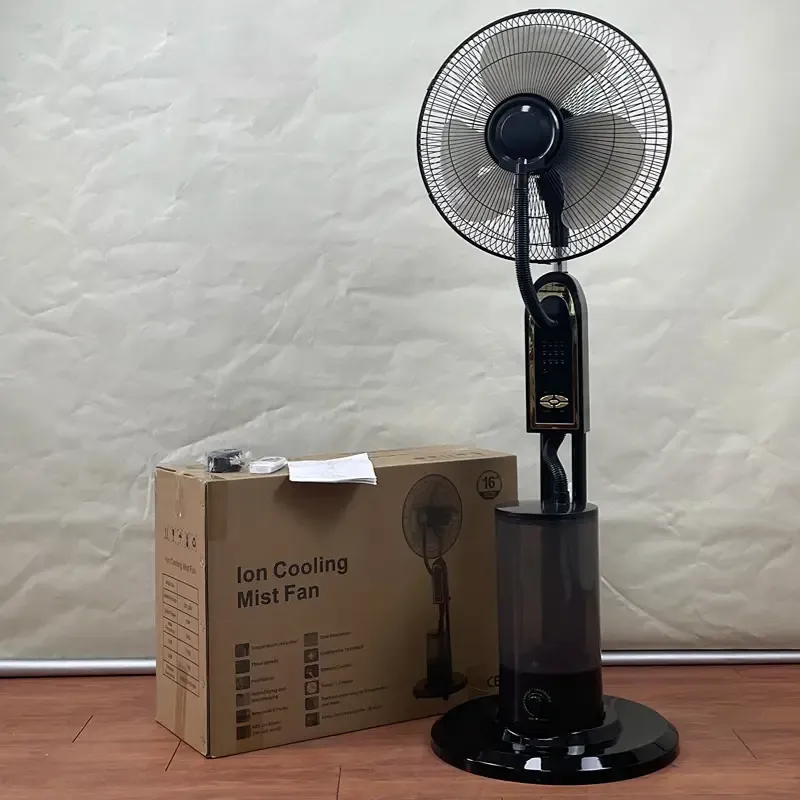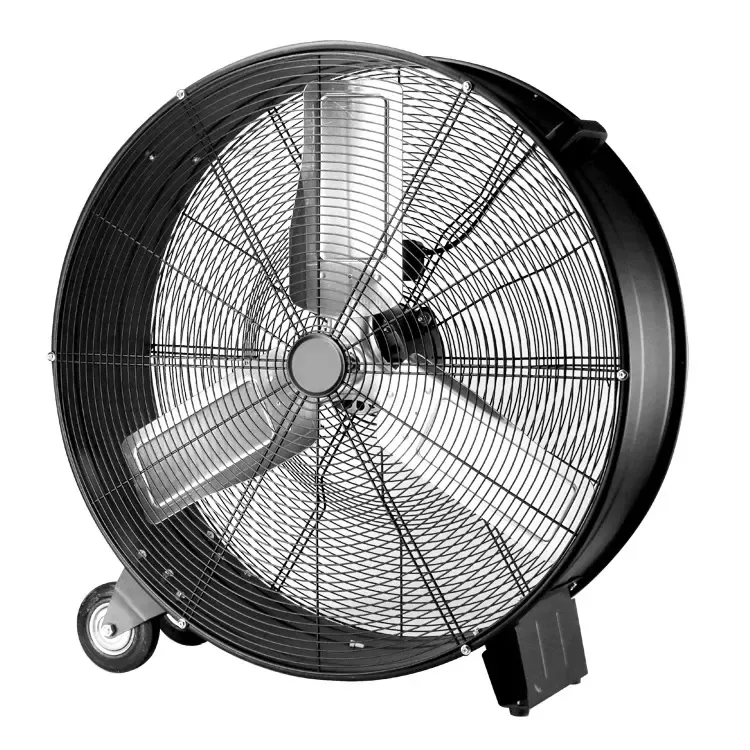
Pedestal Fan
Industrial Pedestal Fan: Wall-Mount or Floor-Stand — Which Fits Your Space?
Wall-mount or floor-stand industrial pedestal fan? Compare floor space, safety, cost, and airflow to pick the right fan for your factory or workshop.
Quick answer: For fixed work stations, aisles, or production lines, choose a wall-mounted fan — it keeps the floor clear and eliminates trip hazards. If you need to move the airflow to where the work is (temporary stations, repair bays, seasonal hot spots), a floor-standing pedestal fan is the better choice. In practice, most factories use both: wall units for permanent coverage, floor units for flexible cooling.
Why This One Choice Matters More Than You Think
In hot summer months, many factories need high-power industrial fans to ventilate and cool the workshop. Choosing the right industrial ventilation equipment matters — and so does deciding between a floor-standing fan and one installed on the wall. Every square metre of factory floor is production capacity. Hang a fan on a wall or column and you hand that space back to pallets, trolleys, and forklift traffic. Put the same fan on a stand and you spend roughly half a square metre of floor space, plus a cable that someone will eventually trip over.
The stakes go beyond space:
- Safety: a pedestal fan standing in a busy aisle is a collision risk for forklifts and pallet trucks, and a trip hazard for pedestrian walkways.
- Cost: wall units cost more to install but never get knocked over; floor units are cheap to buy, but one accident can mean replacing them.
- Coverage: a fixed fan cools a fixed spot perfectly. A movable fan can serve a whole building — just not all at once.
Choose wrong, and for the next three summers you will be managing those fans instead of benefiting from them — extra labour, rising procurement costs, and badly placed units crowding your equipment and congesting production space.
This guide gives you a practical way to decide, based on space, task, and budget.
What Is an Industrial Pedestal Fan?
Industrial pedestal fan (industrial floor fan) — a heavy-duty, high-airflow fan built to run hours a day in factories, warehouses, workshops, poultry farms, and greenhouses. The term is used loosely to cover two mounting styles:
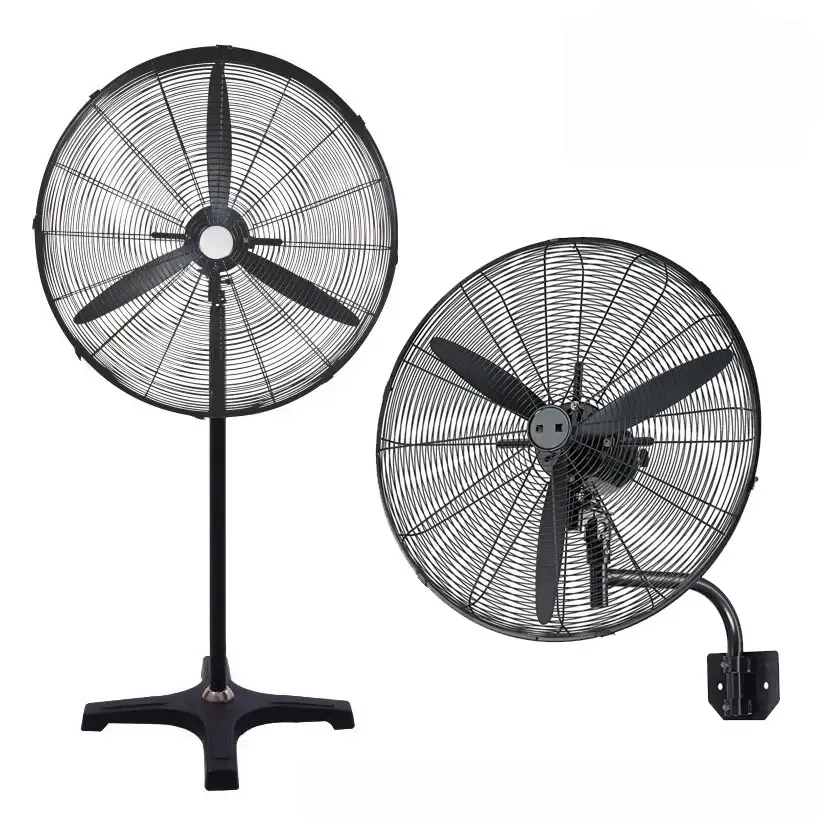
- Wall-mounted fans — fixed to a wall, column, or beam at height, throwing airflow down across a work area.
- Floor-standing (pedestal) fans — standing on a weighted base with an adjustable-height column, aimed directly at people or equipment.
Floor fans are a familiar household appliance — but industrial floor fans differ from domestic ones in many ways. Here is the comparison, side by side:
Feature | Consumer fan | Industrial pedestal fan |
Motor | Aluminium, intermittent duty | 100% full copper, rated for 8–12 hours continuous duty |
Guard / cage | Plastic, thin | Powder-coated steel, impact resistant |
Speeds | 2–3 | 3, with high-velocity mode for spot cooling |
Sizes | 12–16 inch | 18–26 inch, large blades for serious airflow |
Oscillation | Optional | Standard, wide-angle, gear-driven |
Build | Light, tip-over prone | Weighted base or heavy-duty wall bracket |
The bigger the blade, the more air it moves. A 20-inch industrial fan moves roughly 3,000–4,000 CFM (cubic feet per minute), and large 24–26 inch drum fans push well past 6,000 CFM. That is the difference between stirring hot air and actually cutting through it.
Wall-Mounted Fans: Pros, Cons, and Where They Shine
A wall-mounted fan needs a wall. That sounds obvious — but it decides everything else about how you deploy it.
Advantages
- Floor space stays productive. Nothing on the ground means no blind spots to clean around, nothing to collide with, and no plugs to unplug.
- Safer by default. Mounted at 1.8–2.2 m, the head sits above head height — clear of trolleys, forklifts, and pedestrians.
- Consistent coverage of fixed work stations. Assembly lines, packing benches, loading docks, and inspection stations do not move. A wall fan aimed at them runs unattended for years.
- Better throw angle. Mounted high, it projects air downward in a long diagonal arc, covering a work zone several metres wide — not just a single spot.
Limitations
- Zero flexibility. When the production layout changes, the fan is in the wrong place — and re-drilling a bracket is a half-day job.
- Installation requirements. You need a load-bearing wall, column, or beam, a proper bracket, and often an electrician for a fixed circuit.
- Higher upfront cost. Bracket, mounting labour, and electrical work can exceed the price of the fan itself.
Best for: assembly lines, packing stations, corridors, loading docks — anywhere the work station is fixed and so are the people.
Floor-Standing Pedestal Fans: Pros, Cons, and Where They Shine
Floor-standing fans are built for flexible movement and zone cooling.
Advantages
- Plug in and go. No drilling, no electrician, no waiting for maintenance approval. We can customise longer power cords for even more flexible cooling coverage.
- Airflow follows the heat source. Aim it at the heat source directly: the forging area in summer, the cold spots a ceiling fan cannot reach (just move it and plug in), the paint booth in shoulder seasons — one machine, year-round rotation.
- Adjustable height and angle. Direct the airflow precisely to the operator's upper body — the position that makes people feel coolest, fastest — with a wider height and angle range than a drum-style floor blower.
- Lower initial cost. The cheapest way to add spot cooling across a large plant.
Limitations
- Consumes floor space. A heavy base takes up roughly 0.5–0.6 m², plus clearance.
- Trip and collision risk. The power cable must be routed and taped down; in forklift aisles the fan itself can be struck.
- Frequent repositioning has a hidden cost. If workers move the fan daily, by Friday it will be leaning against a wall collecting dust.
Best for: supermarkets and shopping areas, repair bays, temporary stations, machine shops, seasonal hot spots — and buildings where cooling needs change month to month.
Wall-Mount vs Floor-Stand: Side-by-Side Comparison
Factor | Wall-mounted fan | Floor-standing pedestal fan |
Floor space used | None | ~0.5 m² base + clearance |
Installation | Bracket + electrician required (half-day) | Plug into a socket (minutes) |
Upfront cost | Fan + bracket + labour | Fan only |
Flexibility | Fixed position | Move anywhere, any time |
Safety | Above head height, no trip hazard | Cable trip hazard; forklift collision risk |
Airflow direction | Downward diagonal arc, wide zone | Direct spot cooling, adjustable height |
On-site maintenance | Harder (needs dismounting) | Easy (wheel or lift off base) |
Best environment | Assembly lines, corridors, docks | Repair bays, workshops, seasonal use |
How to Choose the Right Industrial Fan in 3 Steps
Step 1: Measure the space before you buy anything
Choose the right type and quantity of industrial fans based on your layout and data. Three numbers decide everything:
- Ceiling height. Under 3 m, wall-mount at 1.8–2.2 m with at least 0.5 m clearance above the head. Above 4 m, a floor fan struggles to throw air that high — wall mounting or a ceiling fan covers the volume better.
- Aisle width. Do not place a standing fan in aisles narrower than 2.5 m.
- Area to be covered. Multiply length × width to get square metres, then match airflow (CFM) to the area — in open plant floors, bigger is better than smaller.
Step 2: Match the fan to the task, not the other way around
Ask one question: do the people move around the work, or does the work move around the people?
- Fixed work station, seated operators → wall-mounted, aimed down at the bench.
- Moving work (repairs, seasonal tasks, shared equipment) → floor-standing, pushed along with the crew.
- Both in one building → a hybrid layout (see below).
Step 3: Balance airflow, energy, and budget
Fans at different price points can deliver the same airflow — so compare three numbers, not one:
- CFM (airflow) — how much air it actually moves.
- Wattage at each speed — a 150 W three-speed fan running 10 hours a day costs less to run than a 300 W unit doing the same job.
- Expected service life — full-copper motors in steel housings routinely outlast aluminium consumer-grade units several times over in continuous factory duty. Factoring in long-term cost, a high-quality industrial fan amortises to very little per year: you get what you pay for. It costs more upfront, but quality and after-sales service are guaranteed — a cheap fan replaced every two years is the expensive option.
The Hybrid Setup Most Factories End Up With
In real workshops and warehouses, cooling is rarely a single-technology job. It is usually a combination: ceiling fans with floor blowers, floor fans with wall-mounted fans, and so on.
The pattern we see most often balances coverage and flexibility:
- ~70% wall-mounted units on fixed lines, docks, and corridors — the permanent backbone, installed once.
- ~30% floor-standing units serving repair bays, quality stations, and shared areas — moved as demand shifts.
Practical tip: start with the fixed stations, measure the improvement, then add mobile units only where complaints continue. This staged approach keeps first-year spend honest and stops you from buying fans nobody uses.
Installation and Safety Notes
- Mount high, aim down. Wall fans work best at 1.8–2.2 m, projecting a diagonal arc across the work zone rather than blasting straight at one person's head.
- Check the substrate. Concrete and steel columns take brackets easily; hollow block walls need through-bolts and a backing plate.
- Manage every cable. Route floor-fan cables along walls, tape them down at crossings, and use a proper socket — never daisy-chain power strips.
- Match the fan to the environment. High-humidity areas (wash-down zones, greenhouses) need moisture-resistant models; dusty or explosive-atmosphere sites require purpose-built fans, not standard industrial fans.
- Clean guards monthly. Dust load on the front guard quietly cuts measurable airflow and shortens motor life.
Sundream Fan Solutions for Tight Spaces and Heavy Bases
Even with the principles above, practical problems remain: the workshop floor is genuinely tight, the budget is fixed, and industrial floor fans are heavy. As a professional ventilation equipment manufacturer, we offer solutions for each of these — and full customisation of our industrial fans.
34-Inch High-Velocity Fan (FA-850): Floor-Stand or Wall-Mount in One Unit
This fan uses a split design: it can stand on its column, or the column can be removed and the head installed on the wall. It solves both problems at once — limited floor space and high-power cooling.
Product specifications:
Item | Specification |
Model | FA-850 |
Size | 34 inch (850 mm blade diameter) |
Voltage | 220V/50Hz (custom 110–120V or 220–240V, 50/60Hz) |
Power | 380 W |
RPM | Fast: 1380 / Medium: 1250 / Slow: 1050 |
Air volume | 21,000 m³/h |
Motor | 100% full-copper winding |
Guard | 2.0 mm thickened steel rods, hand-knotted, powder coated |
Pole | Thickened cast-iron connector pole |
Base | 7 kg cross weighted base |
Blade | Cast aluminium, 3 blades |
Control | Knob type, three-speed adjustable |
Power cord | 1.8 m exposed |
Oscillation | 90° left-right |
Tilt | 45° up-down adjustment |
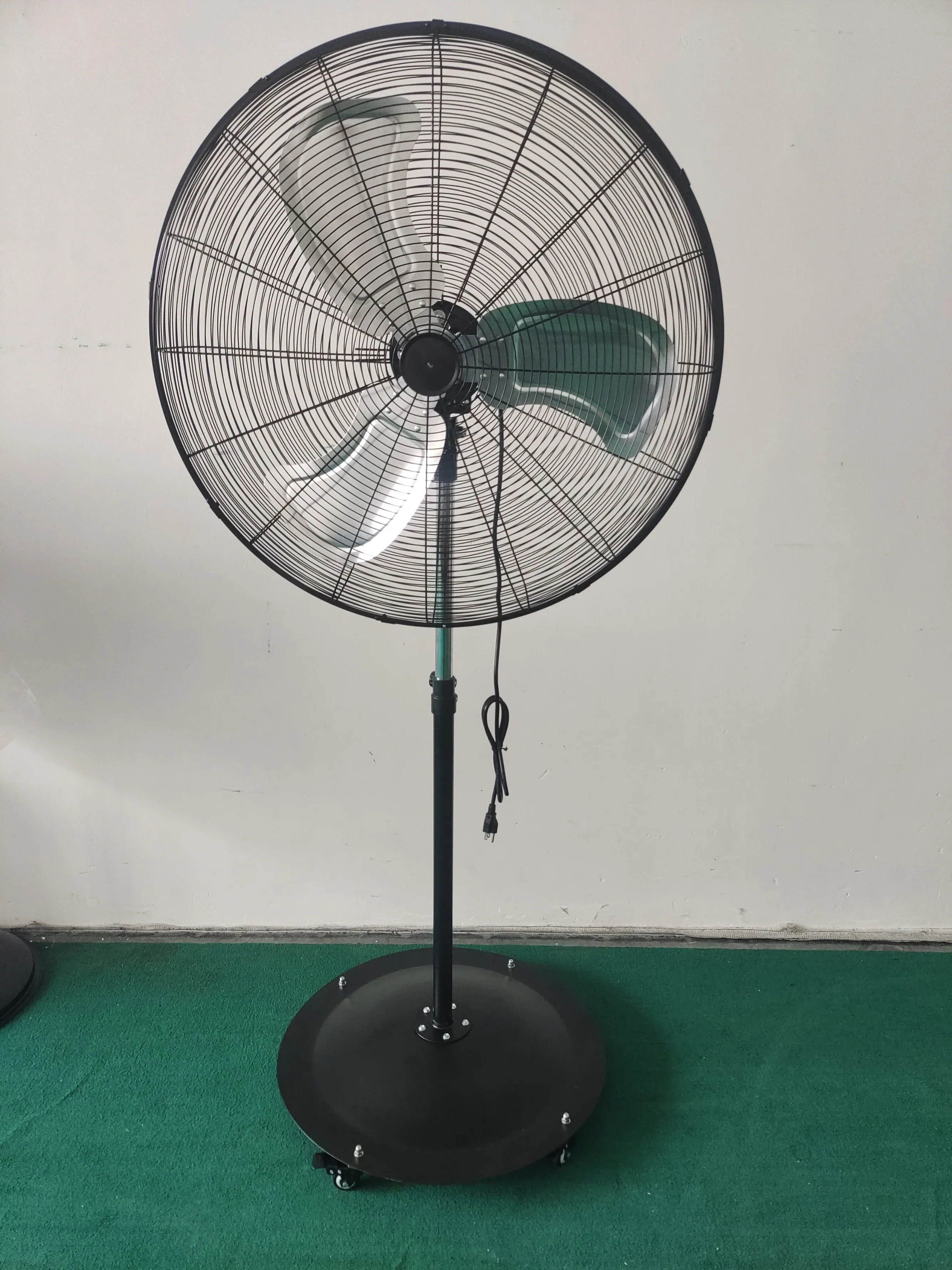
30-Inch Floor Fan with Caster Base
Industrial floor fans need a heavy base to keep the body stable and free of shaking during operation — but that makes the fan heavy and awkward to move, which really hurts the flexibility that makes floor fans useful in the first place.
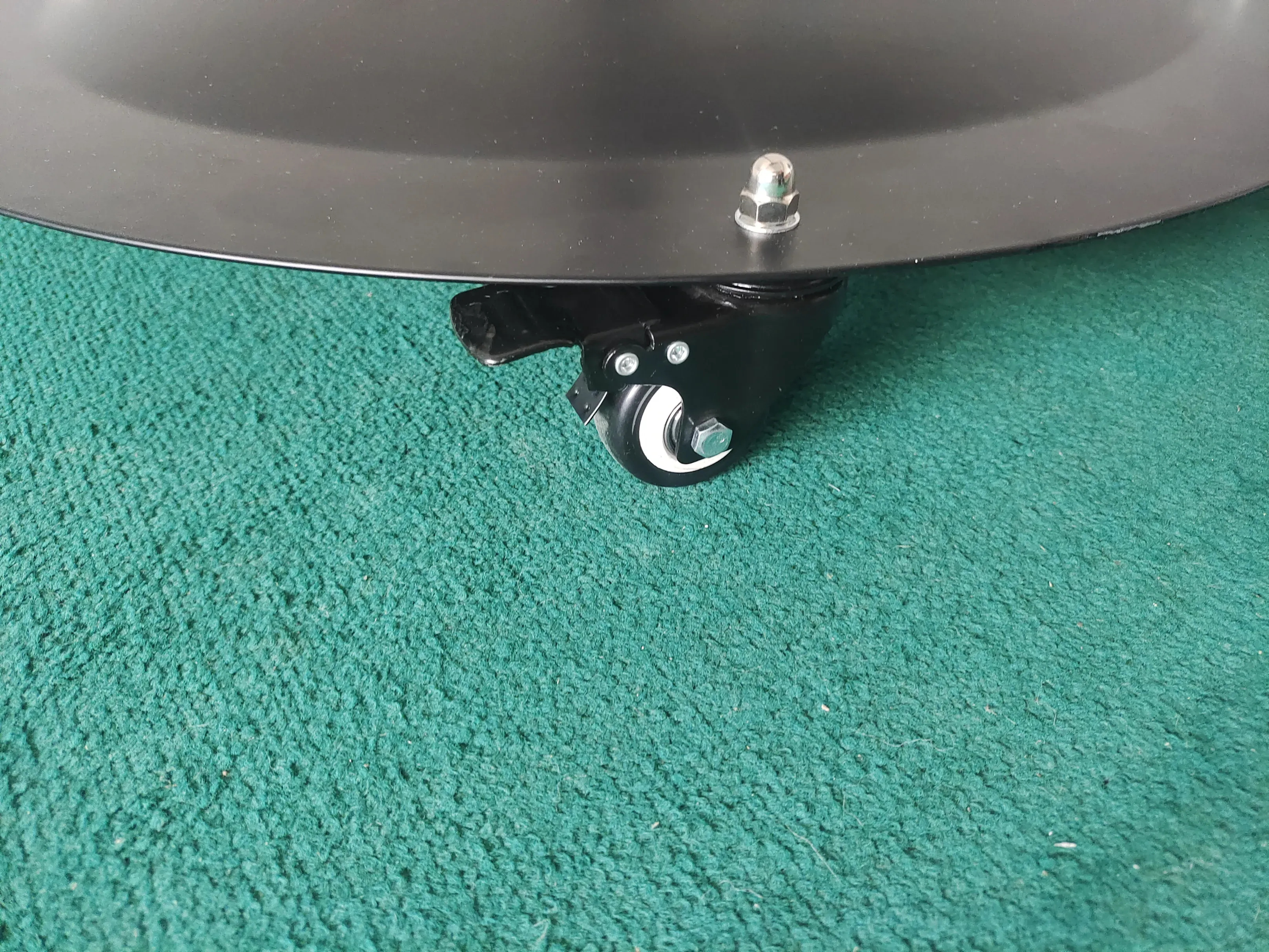
This 30-inch floor fan solves it with a caster base: it rolls for easy repositioning, with brakes on the base to lock it in place when running.
Frequently Asked Questions
Can you wall-mount any industrial pedestal fan?
No. Wall mounting needs a dedicated bracket design with the right hole pattern and load rating. Many floor models have bases that cannot be safely removed. If you want both options, choose a model supplied with a wall-mount kit — one fan body, two mounting methods.
What is the difference between a wall-mount fan and a pedestal fan?
Mounting, reach, and flexibility. A wall-mount fan is fixed at height and throws a wide downward arc across a zone; a pedestal (floor-standing) fan sits on a weighted base, adjusts to operator height, and moves with the work. Same airflow class, different deployment logic.
How many floor fans do I need for my warehouse?
Work backwards from coverage, not from taste. One 24-inch industrial fan covers roughly 100–150 m² of open floor with noticeable airflow; narrow aisles and dense racking cut that figure significantly. Place the first unit at the busiest station, walk the floor, and add units where complaints continue.
Are wall-mounted fans better for warehouses?
For permanent work areas, yes — they keep aisles clear and cannot be knocked over. For everything else, floor-standing units win on flexibility. A realistic warehouse plan uses both, sized by the 3-step method above.
What size industrial fan is best for a factory workshop?
For general workshop cooling, 20–24 inch heads are the sweet spot: enough airflow (3,000–6,000 CFM) to matter, without the mounting and structural demands of 26-inch drum fans. Go 26-inch for open bays, high ceilings, and direct heat sources.
How do I keep a caster-base floor fan from moving?
Our caster-base floor fans roll freely for repositioning and are fitted with brake components on the base to lock them firmly in place during operation.
Make the Call with Real Numbers
Wall-mount or floor-stand comes down to one sentence: fixed work stations want wall-mounted fans; moving work wants floor-standing fans, and most factories need a mix of both. Measure your space, match the fan to the task, and compare CFM against wattage before you compare price tags.
Sundream manufactures 18–26 inch industrial floor fans, drum fans, pedestal fans, and wall-mountable models — full-copper motors, steel guards, engineered for continuous factory duty. As a factory-direct manufacturer, we provide unit specification sheets, airflow data sheets, and OEM/ODM services. Send us your site layout and get a quote plus a sizing recommendation — we will size the fans for your floor.