Sep 22, 2026Floor fan
Tower Fan vs. Floor Fan: What's the Difference?
Tower fan vs floor fan: compare airflow, noise, price, and working principles. Learn how to choose the best floor fan for home or factory cooling. Includes a complete floor fan buying guide.
Tower Fan vs. Floor Fan: What's the Difference?
Introduction
On hot summer days, people often choose between a tower fan and a floor fan for cooling. So what are the main differences? Should you buy a tower fan or a floor fan?
The difference between a tower fan and a traditional electric fan is obvious at first glance—mainly in appearance. But let’s focus on how they work. First, here’s the bottom line: honestly, I don’t recommend tower fans. For home or factory cooling, a floor fan or a standing fan is a better choice. Why? Let’s look at how tower fans and floor fans work.
How a Tower Fan Works
A tower fan is also called a bladeless fan. It has no exposed blades; instead, a motor drives an internal wind wheel to produce airflow.
A tower fan uses a turbine-like impeller to “throw” air out. The impeller rotates to create air pressure, which generates centrifugal airflow. The air is then guided through the inner wall of the housing and blown out. (See the exploded view of a tower fan below.)
[Insert diagram: Tower fan exploded view]
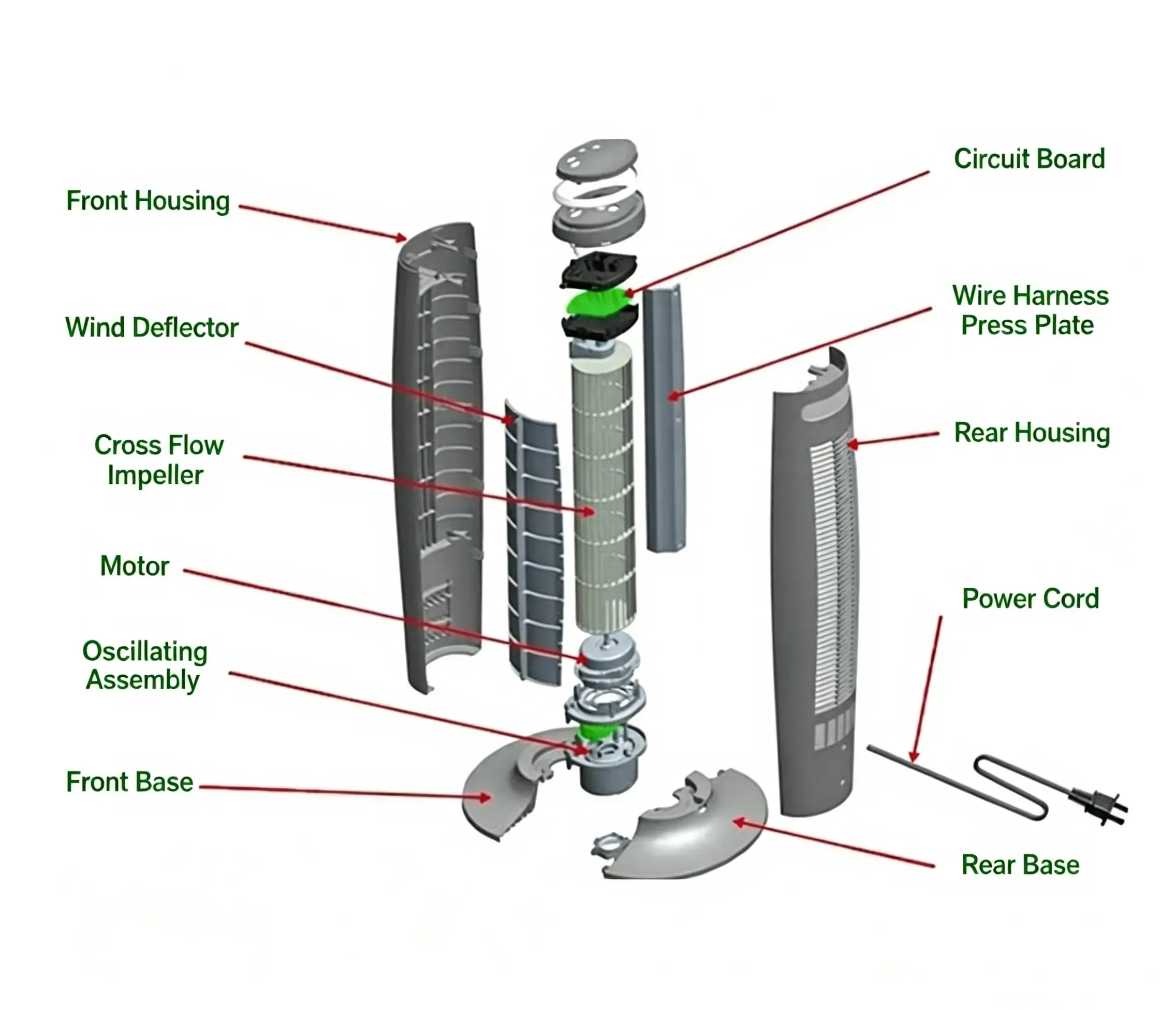
Tower Fan vs. Floor Fan
This working principle leads to several problems:
1. The airflow from a tower fan is weaker than that of a floor fan.
Traditional electric fans—floor fans or standing fans—use blades to cut through the air and move it. The faster the blades spin, the stronger the airflow. A tower fan, however, produces a “roller-like” airflow, so its air volume is smaller. Its air outlet is also narrow, which further reduces wind power.
2. In the narrow body of a tower fan, air frequently collides with the housing, making tower fans noisier than floor fans.
3. Tower fans are more expensive than floor fans.
A tower fan can cost much more than a floor fan with multiple speed settings and oscillation.
Now let’s talk about traditional electric fans. These are the fans we are most familiar with: floor fans, ceiling fans, standing fans, table fans, and more.
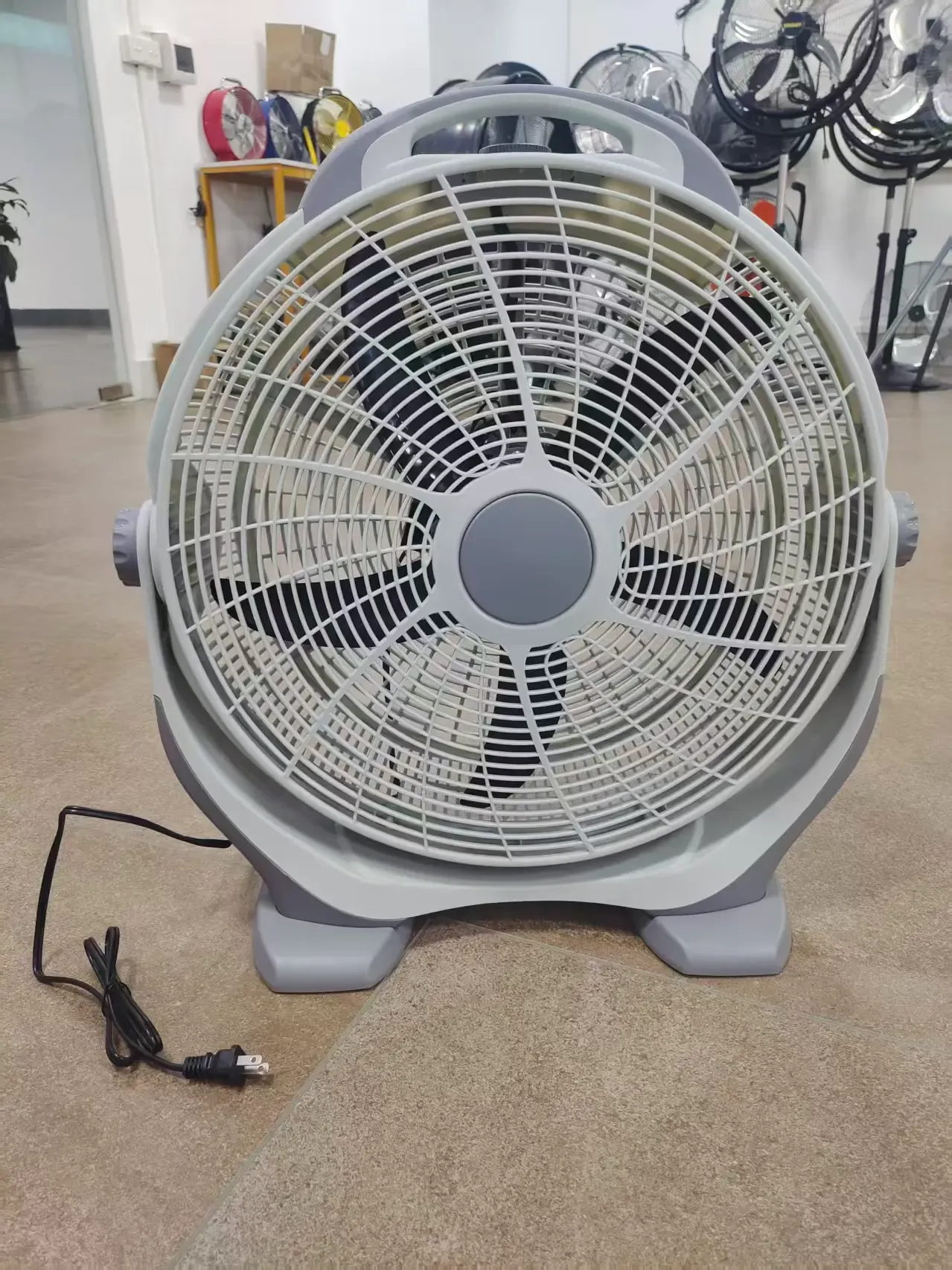
How a Floor Fan Works
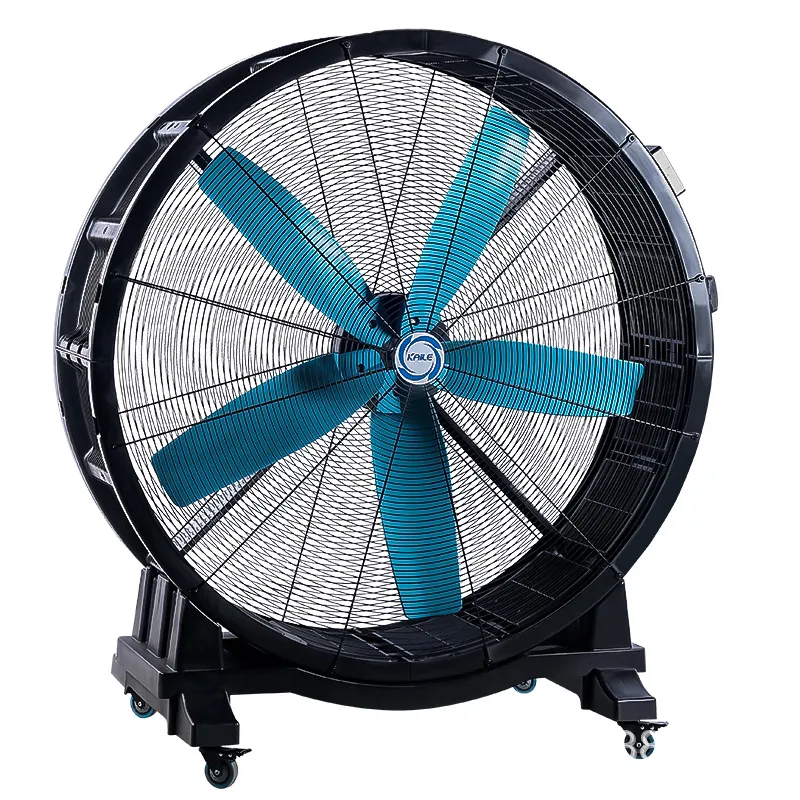
The cooling principle of these fans is simple: a motor drives the blades to produce strong airflow, which moves the air, accelerates sweat evaporation on the human body, and makes people feel comfortable. The fan has a wide air outlet angle and broad coverage, making it very effective for cooling.
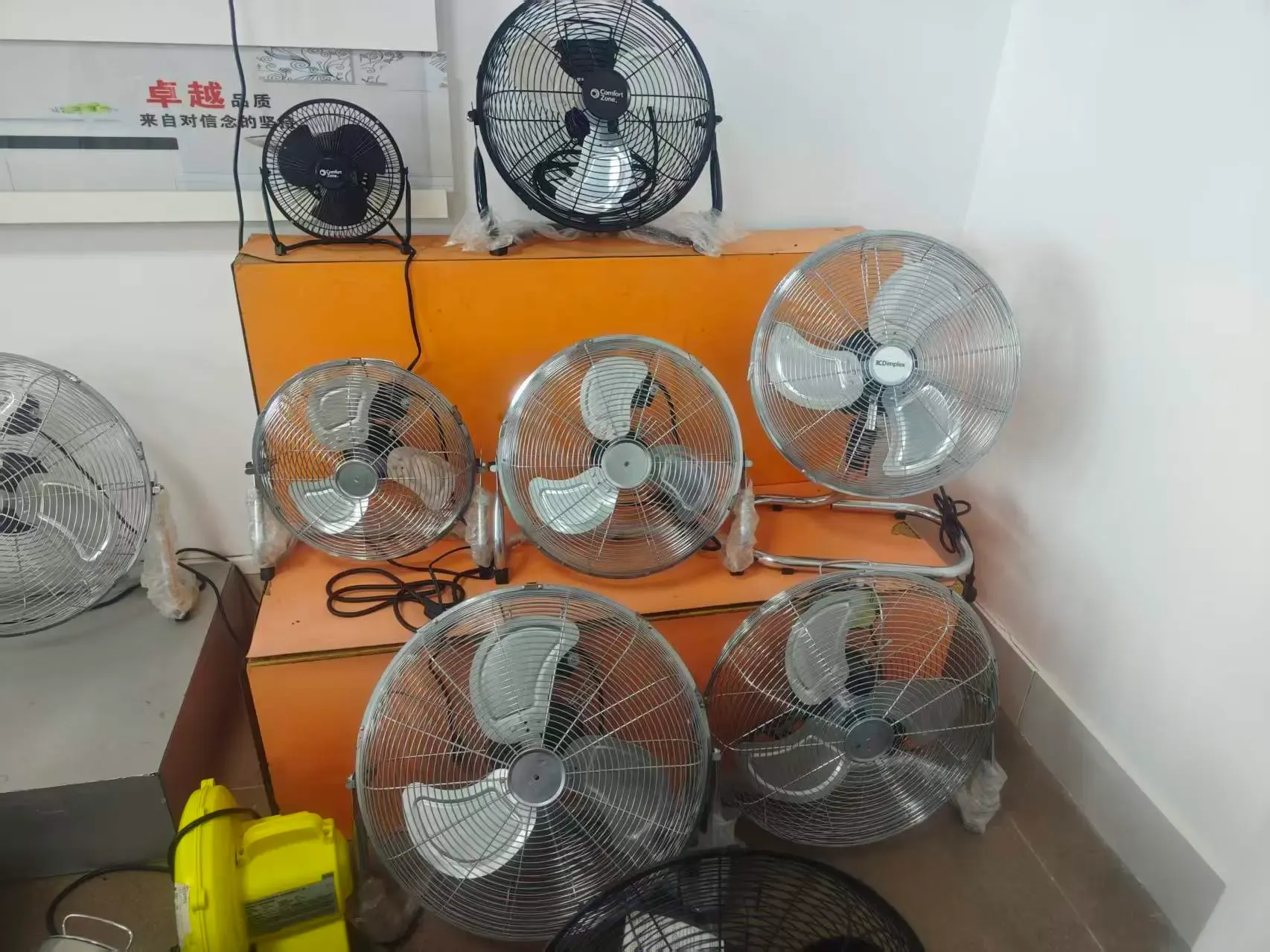
How to Choose the best Floor Fan
Let me share some tips on choosing a floor fan or standing fan.
Generally speaking, an ideal electric fan should have four qualities: strong airflow, soft airflow, low noise, and wide coverage. If it also has some practical functions, even better. Let’s look at how to choose an ideal floor fan based on these points.
1. What kind of electric fan has strong airflow?
Airflow is determined by two factors: power and blade design. Blade design mainly refers to blade curvature and width. Manufacturers usually do not disclose these data, so when buying, you can only judge by power. Currently, electric fan power is mostly between 30W and 60W. With the same number of blades, higher power means stronger airflow.
2. What kind of electric fan produces soft airflow?
Fan blades come in 3, 5, 7, and 9 blades. The more blades, the smaller the volume of air each blade cuts, and the softer the airflow feels on the body.
3. What kind of electric fan is quiet?
Normally, noise depends on the motor, but because electric fan motors are low-power, motor noise is negligible. The main noise comes from wind noise. When buying, the more blades, the lower the noise. This is because with more blades, each blade contacts a smaller air surface during rotation, creating less force and therefore less sound.
4. Wide coverage.
Pay attention to left-right oscillation range and tilt angle. These greatly affect the user experience. The larger, the better. Generally, a left-right oscillation range of about 100 degrees and a tilt angle of about 30 degrees is good. A high-quality electric fan can achieve about 120 degrees oscillation and a 50-degree tilt angle.
5. Practical features to consider.
① Timer function: Most electric fans have a timer. Pay attention to the length of the timer—the longer, the more flexible.
② Remote control: Nowadays, many electric fans come in both mechanical and remote-control versions. A remote control is very convenient—you can adjust the speed without getting up.
For individual buyers, I suggest choosing a branded floor fan. You can buy from Amazon, eBay, Walmart, Target, Shopify, SHEIN, Temu, or directly from offline stores.
If you are a distributor, you can buy from us. We are a professional fan manufacturer in China, supporting OEM and ODM services.

Conclusion
I do not recommend tower fans. Their main disadvantages are high price and low airflow.
From the floor fan buying guide above, choosing a 60W 9-blade fan may seem like a good choice, but it is not necessarily. More blades do make the airflow softer and quieter, but the air volume will also be smaller. Therefore, it is best to choose a 5-blade fan with about 60W power. This ensures both airflow and comfort, and the noise is not too loud.